Digital Leadership, AI and Innovation Management
Leading people, making responsible technology decisions and building a culture in which useful ideas become measurable value.
Mind Skills India Signature Line: “Technology expands what an organisation can do; leadership determines what it ought to do.”
Home / Leadership Programme / Digital Leadership
Learning Outcomes
By the end of this lesson, learners should be able to explain digital leadership, distinguish digitalisation from transformation, identify suitable and unsuitable AI applications, design an innovation process, evaluate ethical risks, lead technology-related organisational change and create a practical implementation roadmap.
1. Introduction: Leadership in a Technology-Shaped World
Leadership has always involved creating direction, coordinating effort and making decisions under uncertainty. Digital technology changes the speed, scale and visibility of these responsibilities. A decision that previously relied on monthly reports may now be supported by real-time dashboards; a customer interaction once restricted to an office can now happen through a mobile application. Yet increased information does not automatically create increased wisdom.
Digital leadership is the ability to guide people, processes and technology towards worthwhile organisational outcomes while maintaining trust, accountability and adaptability. It is not merely the ability to use software. A digitally capable leader recognises opportunities, evaluates limitations, develops employees and ensures that innovation serves human and organisational needs.
Three ideas anchor this lesson. Digital leadership provides direction; artificial intelligence extends analytical capability; innovation management converts promising ideas into useful outcomes. The three reinforce one another but are not interchangeable.
2. Understanding Digital Leadership
2.1 Definition and scope
Digital leadership is the purposeful use of digital capabilities to improve strategy, operations, employee experience and stakeholder value. The term digital capability means an organisation’s practical ability to use technology, data, skills and processes effectively. It includes technical understanding, but its deeper concern is organisational judgement.
2.2 Six competencies of a digital leader
Strategic foresight
Anticipating possible technological developments without treating every trend as inevitable.
Data literacy
Understanding what data can reveal, where it is incomplete and how conclusions can mislead.
Human-centred leadership
Considering employees, customers and vulnerable stakeholders when adopting technology.
Experimentation
Testing ideas on a manageable scale before committing major resources.
Cross-functional collaboration
Bringing operations, technology, risk, finance and frontline employees into shared decisions.
Ethical accountability
Taking responsibility for the outcomes of technology-enabled decisions.
2.3 Traditional and digital leadership
| Dimension | Conventional emphasis | Digital leadership emphasis |
|---|---|---|
| Information | Periodic reports | Timely, verified information with context |
| Planning | Fixed plans | Clear direction with iterative adjustments |
| Coordination | Hierarchical communication | Connected, cross-functional collaboration |
| Learning | Occasional training | Continuous skill development |
| Control | Supervision of activities | Governance of outcomes, risks and systems |
These are differences of emphasis rather than absolute opposites. Effective organisations often combine stable controls with flexible learning.
3. Digitalisation and Digital Transformation
Digitisation converts analogue information into digital form, such as scanning paper records. Digitalisation uses digital tools to improve an existing activity, such as allowing customers to submit requests online. Digital transformation involves more fundamental changes in how an organisation creates value, structures work and serves stakeholders.
Information becomes digital
Processes improve
Value model evolves
Consider a college that scans admission forms. This is digitisation. If it introduces an online application and fee-payment system, it has digitalised an administrative process. If it redesigns student support around integrated digital services, personalised academic guidance and improved accessibility, it is moving towards digital transformation.
3.1 Why transformation initiatives fail
Projects may struggle because the problem is poorly defined, employees are excluded, data quality is weak, the technology is difficult to integrate or success is measured only by installation rather than actual adoption. Buying a system is an expenditure; achieving meaningful behavioural and operational improvement is transformation.
4. Artificial Intelligence in Management
4.1 Meaning of AI
Artificial intelligence (AI) refers broadly to computational systems that perform tasks commonly associated with human intelligence, including recognising patterns, generating content, interpreting language and supporting predictions. Machine learning is an approach in which systems identify patterns from data. Generative AI creates new text, images, code or other content based on learned patterns. These systems can be useful, but their outputs may be inaccurate or inappropriate.
4.2 Managerial applications
Operations
Forecasting demand, identifying bottlenecks and supporting inventory planning.
Customer service
Classifying requests, drafting responses and routing issues to the right team.
Human resources
Supporting training materials and workforce planning, subject to privacy and fairness controls.
Finance and risk
Highlighting unusual transactions and assisting analysis, with human review.
Education
Developing practice materials and providing formative feedback checked by educators.
Entrepreneurship
Analysing feedback, exploring market segments and testing service concepts.
4.3 Capabilities and limitations
AI can process large volumes of information quickly and help detect recurring patterns. It does not necessarily understand the real-world meaning of an output, possess complete information or exercise moral judgement. Generative systems can produce hallucinations (plausible-sounding but unsupported or false statements). Managers must therefore check evidence, verify critical facts and avoid treating automated recommendations as unquestionable authority.
5. Human–AI Collaboration in Decision-Making
A practical leadership principle is “AI may assist the analysis; accountable people must own consequential decisions.” The appropriate level of human oversight depends on the seriousness, reversibility and legal implications of the decision.
5.1 Three questions before trusting an AI output
- Is the information reliable? Check sources, completeness and relevance.
- Who could be harmed? Examine errors, exclusion, discrimination and privacy exposure.
- Who remains accountable? Identify the human decision-maker and escalation route.
For example, an AI tool may flag an unusual loan application for additional review. That flag is a reason to investigate, not proof of misconduct. The reviewer should examine valid evidence, applicable rules and opportunities for correction.
6. Innovation Management: Turning Ideas into Value
Innovation management is the structured process of identifying opportunities, developing solutions, testing assumptions and implementing improvements that create value. Invention is the creation of something new; innovation requires that an idea be applied in a way that delivers benefit. Innovation may concern products, services, processes, business models or management practices.
6.1 Types of innovation
Incremental innovation makes progressive improvements to existing offerings. Radical innovation introduces a substantially different solution. Process innovation improves how work is performed. Business-model innovation changes how an organisation creates, delivers or captures value.
6.2 A practical innovation cycle
A pilot is a limited trial used to test whether an idea works under realistic conditions. Scaling means expanding an approach after sufficient evidence supports its effectiveness. A failed pilot can still be valuable when it reveals assumptions early and prevents larger losses.
6.3 Building an innovation culture
Employees need psychological safety (confidence that respectful questions and good-faith concerns can be raised without humiliation), clear priorities, resources for experiments and recognition for learning. Leaders should distinguish between responsible experimentation and careless risk-taking. Innovation becomes sustainable when curiosity is supported by disciplined evaluation.
7. The Mind Skills India D–A–I Leadership Framework
This teaching framework integrates three connected leadership responsibilities. It is a Mind Skills India instructional synthesis, not a separately validated scientific model.
D — Direction
Define the organisational problem, purpose, stakeholders and intended value.
A — Augmentation
Use appropriate digital tools and AI to strengthen, rather than replace, responsible judgement.
I — Implementation
Test, learn, govern, measure and institutionalise useful innovation.
Direction without implementation remains aspiration. Augmentation without direction becomes technological distraction. Implementation without governance can create avoidable harm. Strong digital leadership connects all three.
7.1 Example: A service organisation
A service centre receives recurring complaints about delayed responses. The leader first defines the goal: reduce resolution time while preserving service quality. The team then considers a digital ticketing system and AI-assisted classification. A small pilot measures response time, classification errors, customer satisfaction and employee workload. Only after reviewing these results does the organisation decide whether to expand the system.
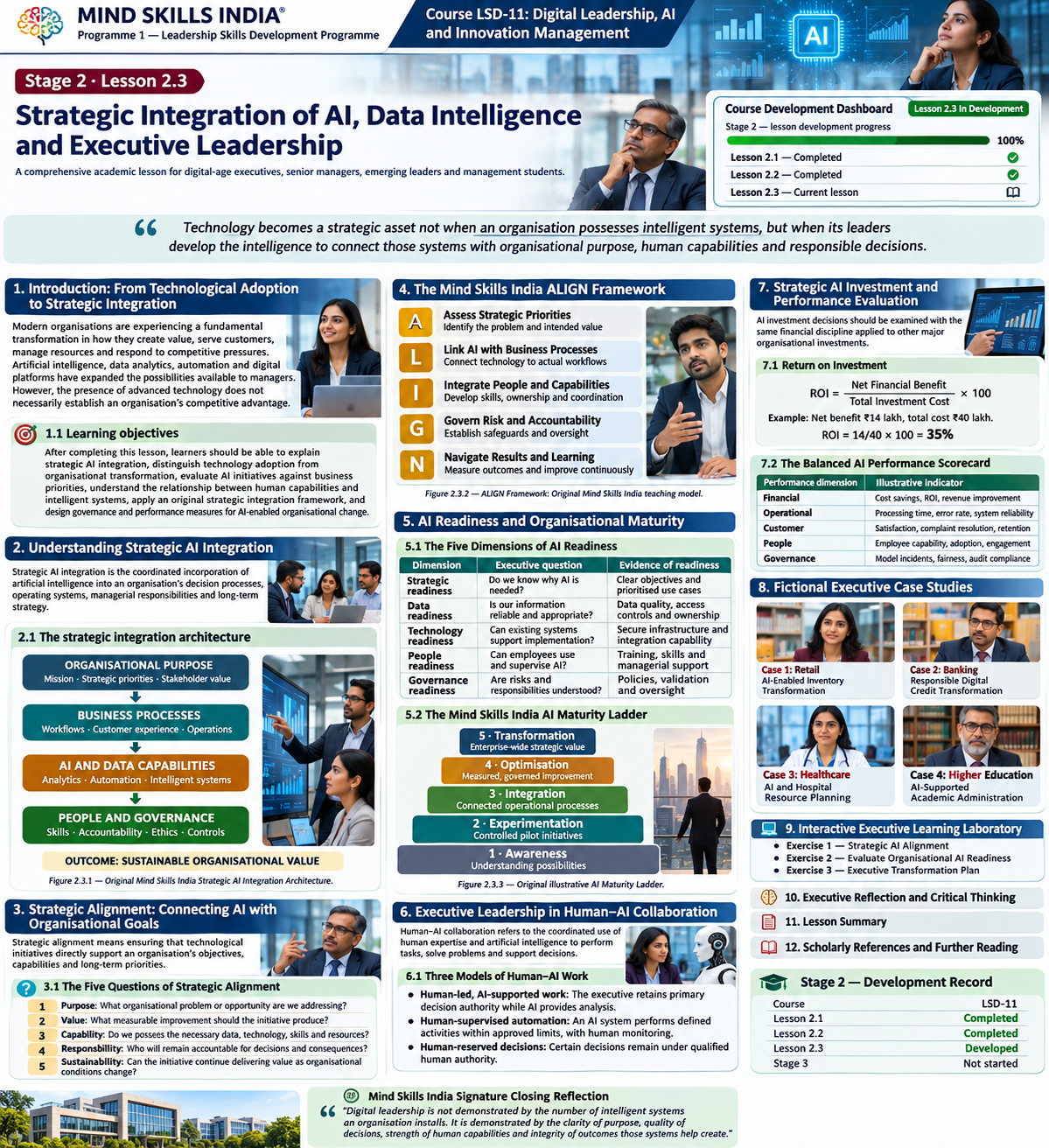
Visual guide · Strategic AI Leadership Integration
Use this companion graphic to connect organisational purpose, AI and data capabilities, and accountable executive judgement. The lesson text above explains the D–A–I framework.
8. Responsible AI, Ethics and Governance
AI governance refers to the policies, responsibilities and controls used to ensure that AI systems are developed and used appropriately. A responsible leader must consider fairness, transparency, privacy, security, reliability and accountability throughout a system’s lifecycle.
| Risk | Leadership response |
|---|---|
| Biased outputs | Evaluate performance across relevant groups and investigate unequal impacts. |
| Private data exposure | Minimise data collection, restrict access and use approved systems. |
| Incorrect recommendations | Require verification, escalation and human review for consequential decisions. |
| Unclear responsibility | Assign a named process owner and maintain decision records. |
| Security vulnerabilities | Assess vendors, permissions, integrations and incident-response procedures. |
| Employee mistrust | Explain purpose, consult staff and provide training and feedback channels. |
9. Leading People Through Digital Change
Digital transformation can create uncertainty about roles, performance expectations and professional identity. Leaders must recognise these concerns rather than dismiss them as resistance. Change leadership is the process of helping people understand why change matters, what it means for their work and how they can participate effectively.
9.1 A six-stage change roadmap
- Explain the need: Present the operational problem and evidence.
- Build participation: Consult users, frontline teams and affected stakeholders.
- Develop capability: Offer practical training and accessible support.
- Start small: Pilot in a controlled setting with measurable objectives.
- Learn visibly: Report results, failures and adjustments transparently.
- Embed the improvement: Update processes, responsibilities and governance.
Leadership communication should be frequent, specific and two-way. Staff need opportunities to report problems that a dashboard may not capture. Successful adoption is demonstrated through improved outcomes, not simply high login counts.
10. Applied Case Studies
Case A: The Bank Branch and the Automated Alert
Fictional teaching case. A branch operations manager introduces a system that flags unusual account activity. The team initially assumes every alert indicates wrongdoing. Customer complaints increase because legitimate transactions are repeatedly delayed. The manager reviews the process and discovers that the tool was implemented without clear thresholds for escalation or a consistent review protocol.
The manager establishes a human review process, documents reasons for decisions, trains employees to distinguish a signal from a conclusion and tracks both false alerts and confirmed concerns. The case demonstrates that automation improves control only when supported by sound judgement and fair procedures.
Case B: A College Redesigns Student Support
Fictional teaching case. An academic coordinator notices that students repeatedly ask the same administrative questions. A chatbot is proposed. Instead of launching it immediately, the coordinator interviews students, identifies accessibility needs, reviews data protection obligations and tests a limited FAQ assistant. The college ensures that complex welfare and academic decisions are routed to qualified staff.
The pilot is evaluated using answer accuracy, unresolved cases and student feedback. The central lesson is that technology should support a better student experience rather than merely reduce staff contact.
Case C: A Laundry Enterprise Tests Service Innovation
Fictional teaching case. A premium laundry business wants to improve pickup scheduling and garment tracking. The owner considers a digital booking interface, barcode-based status updates and demand forecasts. Before investing, the team maps the customer journey and identifies the largest source of delay: inconsistent handovers between collection and processing.
A pilot introduces a standard handover checklist and simple digital tracking. The owner measures misplaced-item incidents, delivery punctuality and repeat customer satisfaction. The case illustrates why process clarity must accompany technology investment.
11. Reflection and Practical Exercises
Exercise 1: Digital Leadership Self-Audit
Rate yourself from 1 (needs development) to 5 (strong) on strategic foresight, data literacy, employee involvement, experimentation, ethical awareness and change communication. Identify the two lowest-rated competencies and write one action for improving each over the next 30 days.
Exercise 2: The AI Decision Boundary
Select a recurring managerial task. Divide its steps into three categories: tasks that can be automated with routine checks, tasks where AI may provide recommendations but humans must decide, and tasks that should remain directly human-led. Explain your reasoning using risk, reversibility and stakeholder impact.
Exercise 3: Innovation Pilot Canvas
| Problem to solve | Describe the unmet need in one sentence. |
|---|---|
| Stakeholders | Who benefits, participates or may be adversely affected? |
| Proposed improvement | What exactly will change? |
| Pilot scope | Where, with whom and for how long will it be tested? |
| Measures | What outcomes, costs and risks will be tracked? |
| Decision rule | What evidence would justify improving, scaling or stopping? |
Signature Reflection
12. Knowledge Assessment
Attempt each question before expanding its answer.
1. How is digital transformation different from digitisation?
Digitisation converts information into digital form; transformation changes how an organisation operates and creates value.
2. Why should AI recommendations not be treated as final decisions in high-stakes situations?
AI can produce errors, reflect bias and lack relevant context. Human oversight, verification and accountability remain necessary.
3. What distinguishes innovation from invention?
Innovation requires practical application that creates value, whereas invention concerns the creation of something new.
4. Name three indicators of a successful technology pilot.
Examples include improved service quality, lower processing time, fewer errors, stronger accessibility, acceptable costs and manageable risks.
5. What are the elements of the Mind Skills India D–A–I Framework?
Direction, Augmentation and Implementation.
6. What is psychological safety and why does it matter for innovation?
It is the confidence to raise questions, ideas and concerns without humiliation. It supports learning and early detection of problems.
Application assignment
Write a 500–700-word proposal for a responsible digital improvement in an organisation of your choice. Include the problem, expected value, proposed technology, human responsibilities, risks, pilot plan and three success measures.
Completion criteria
Complete the self-audit, innovation canvas and application assignment; explain the six assessment concepts accurately; and demonstrate an ability to balance opportunity with ethical and operational controls.
13. Lesson Summary and Forward Orientation
Digital leadership is not a contest to adopt the greatest number of technologies. It is the disciplined practice of selecting tools that serve organisational purpose, improving the quality of decisions and preparing people for new ways of working. AI offers valuable analytical and creative support, but its outputs require verification and proportionate oversight. Innovation management creates the pathway from an idea to a measurable improvement through experimentation, learning and implementation.
The essential leadership principle is clear: progress should be judged by the value created for people and organisations, not by the novelty of the technology itself. This lesson prepares learners to approach subsequent leadership topics with stronger digital judgement, an innovation mindset and a commitment to responsible change.
14. Further Reading and Conceptual References
- John P. Kotter, Leading Change — organisational change and leadership.
- Everett M. Rogers, Diffusion of Innovations — how innovations spread.
- Clayton M. Christensen, The Innovator’s Dilemma — innovation and organisational disruption.
- David L. Rogers, The Digital Transformation Playbook — strategic approaches to digital transformation.
- OECD, OECD AI Principles — trustworthy and responsible AI.
- NIST, AI Risk Management Framework (AI RMF 1.0) — identification and management of AI risks.
These references support further study; the teaching framework and signature reflections above are original instructional material for Mind Skills India.
To print or save this lesson as a PDF, use your browser’s Print command. Educational material. All case studies are fictional illustrations.