Our Programmes / Leadership
The flagship learning pathwayLeadership Skills
Development Programme
Build the clarity to understand yourself, the judgement to make thoughtful decisions and the capability to guide people with purpose.
₹1,200.00Full programme fee
Leadership begins with the mind.
Leadership extends beyond a designation. It involves self-understanding, thoughtful choices, constructive relationships and responsibility for the effect of our actions. This programme connects clear academic explanations with reflection, fictional professional cases and practical exercises.
It is designed for working professionals, managers, entrepreneurs, educators and learners preparing for leadership responsibilities.
Develop inner clarity
Examine the connection between personal awareness, values, judgement and leadership behaviour.
Work with people
Reflect on communication, trust, participation and the human responsibilities of leadership.
Lead purposeful change
Connect strategic thinking, responsible technology decisions and innovation with practical organisational needs.
Digital Leadership, AI and Innovation Management
A complete standalone lesson with definitions, comparison tables, the Mind Skills India D–A–I teaching framework, three fictional cases, reflection exercises, assessment questions and further reading.
What you will explore
- Digital leadership and transformation
- Human–AI collaboration and accountability
- Innovation pilots and implementation
- Ethics, governance and change leadership
- Application in banking, education and enterprise
The lesson is available for independent reading. It does not represent completion of the full programme.
AI, Data Analytics and Executive Decision-Making
Explore the EVIDENCE framework, uncertainty, governance and four fictional executive cases in LSD-11 · Stage 2 · Lesson 2.2.
Explore executive decision-makingExplore all 12 leadership modules
Open any module to read the lessons, work through cases and practise with the assessment and action plan.
LSD-01
Foundations of Leadership and Leadership Theories
LSD-02
Strategic Thinking and Visionary Leadership
LSD-03
Emotional Intelligence for Effective Leadership
LSD-04
Leadership Communication, Influence and Persuasion
LSD-05
Ethical Leadership, Governance and Corporate Values
LSD-06
Leading Organisational Change and Transformation
LSD-07
Conflict Resolution, Negotiation and Crisis Leadership
LSD-08
Building High-Performance Teams and Leadership Culture
LSD-09
Decision-Making Under Uncertainty and Risk
LSD-10
Managing Corporate Toxicity and Psychological Safety
LSD-11
Digital Leadership, AI and Innovation Management
LSD-12
Executive Presence, Leadership Legacy and Succession
Bring your curiosity.
Leave with an action.
- Read the available lesson and note the key ideas.
- Complete the reflection questions and practical exercises.
- Apply one insight to a real situation.
- Contact us about your learning interests or educational collaboration.
“The quality of leadership grows with the quality of thought behind it.”
Mind Skills India learning reflection
Mind Skills India · Programme 1
Leadership Course Library
Explore twelve modules with core lessons, short research readings, fictional cases, assessments and action plans. Choose a module below to start.
LSD-01
Foundations of Leadership and Leadership Theories
LSD-01 · Visual guide
Choosing a leadership response
- 1. Read the situationAssess urgency, risk and task clarity.
- 2. Assess capabilityCheck what the person can do independently.
- 3. Choose a responseDirect, coach, support or delegate.
- 4. Review impactCheck quality and adjust the support.
Stage 1
Introduction
Explain how leadership differs from positional authority, compare major theories and choose behaviours suited to people, purpose and context.
Mind Skills India Signature Line
A designation may put you in charge. The quality of your influence determines what people can do together.
Before you begin
Choose one real leadership situation you can revisit over the course. Record the current outcome, the people affected and the part of the work you can influence. Keep workplace examples anonymous in group discussions.
Practice framework
- Observe three leadership behaviours and their effects
- Diagnose one task and the team's capability
- Try one directive and one coaching behaviour
- Review performance and ask the team what helped
Stage 2
Conceptual lessons
Work through the lessons in sequence. Each lesson includes a worked example and a question to check your understanding.
2.1 · Leadership, management and shared purpose
Concept and explanation
Leadership is a process of influence towards a shared purpose. Management helps organise the people, time and resources needed to achieve it. In practice the same person often performs both. Setting a staffing rota coordinates the work. Helping staff see why service reliability matters and inviting them to solve a recurring handover failure exercises leadership. Formal authority gives the manager permission to allocate work. Credibility grows through competence, consistency and fair decisions.
Worked example
At a college, the timetable coordinator has authority to publish class schedules, while a lecturer with no formal title helps departments agree a workable common period. Both contributions matter. Ask who can convene people, who can decide and who must implement the decision.
Practice and reflection
Map those three roles for a task you lead. Write a one-sentence purpose that describes the outcome for the people served.
What would tell you that your response helped? Write down one observation you could check after the next comparable situation.
Knowledge check
Can a person without formal authority lead?
Show the answer
Yes. Their influence can help a group move towards a shared outcome, while formal decision rights still need to be respected.
Further reading
- Stogdill, R. M. (1948), Personal Factors Associated with Leadership: A Survey of the Literature.
- Fiedler, F. E. (1967), A Theory of Leadership Effectiveness.
- Burns, J. M. (1978), Leadership.
2.2 · Trait and behavioural approaches
Concept and explanation
Trait approaches examine relatively enduring qualities such as confidence, persistence and sociability. Behavioural approaches examine actions that can be seen and practised, such as clarifying a task or inviting input. Traits can help explain why a behaviour comes more easily to one person. The situation determines whether that behaviour is useful. A persistent leader can sustain effort through a difficult rollout and can also persist with a failing plan after evidence calls for a change.
Worked example
A warehouse supervisor gives clear instructions during a safety stoppage. In a process review, the same supervisor asks operators to explain where the procedure breaks down. These are observable choices about direction and participation.
Practice and reflection
Translate “be more confident” into two behaviours you can rehearse. Ask a colleague what changed when you tried them.
What would tell you that your response helped? Write down one observation you could check after the next comparable situation.
Knowledge check
Which is easier to coach directly: confidence or stating a recommendation and its reason in the first minute?
Show the answer
The observable behaviour can be practised and assessed directly.
Further reading
- Stogdill, R. M. (1948), Personal Factors Associated with Leadership: A Survey of the Literature.
- Fiedler, F. E. (1967), A Theory of Leadership Effectiveness.
- Burns, J. M. (1978), Leadership.
2.3 · Contingency and situational judgement
Concept and explanation
Contingency theories relate leadership effectiveness to the fit between the leader and the situation. Fiedler’s model uses leader–member relations, task structure and position power to describe the setting. Situational judgement also asks what people know about this particular task and how much support they need. A senior employee can be a novice when a new system arrives. Diagnose capability at the task level before choosing how much to direct.
Worked example
A software delivery lead gives a new analyst a worked example for an unfamiliar report, then invites an experienced analyst to design their own checks. Both are held to the same quality standard. Support changes as each person demonstrates competence.
Practice and reflection
Choose a task. Rate its clarity, risk and the assignee’s experience. Decide what must be specified, what can be negotiated and when to review.
What would tell you that your response helped? Write down one observation you could check after the next comparable situation.
Knowledge check
Why would a leader increase structure even for an experienced team?
Show the answer
A new, urgent or high-risk task may need clear roles and escalation rules until capability is demonstrated.
Further reading
- Stogdill, R. M. (1948), Personal Factors Associated with Leadership: A Survey of the Literature.
- Fiedler, F. E. (1967), A Theory of Leadership Effectiveness.
- Burns, J. M. (1978), Leadership.
2.4 · Transactional and transformational leadership
Concept and explanation
Transactional leadership sets expectations and links performance to consequences or recognition. Transformational leadership draws people towards a shared purpose, encourages inquiry and develops individuals. An emergency department needs reliable procedures as well as the motivation to improve a weak process. A compelling vision can organise effort, but it still needs clear responsibilities and honest measures.
Worked example
A customer support manager clarifies the response-time standard, then brings agents together to redesign how difficult cases are escalated. The standard provides a fair baseline. Participation builds ownership of the improvement.
Practice and reflection
Write one explicit performance agreement and one purpose statement for the same team. Explain how you would check that the two support each other.
What would tell you that your response helped? Write down one observation you could check after the next comparable situation.
Knowledge check
What keeps a compelling vision from becoming a slogan?
Show the answer
Specific responsibilities, resources, opportunities to challenge assumptions and observable measures.
Further reading
- Stogdill, R. M. (1948), Personal Factors Associated with Leadership: A Survey of the Literature.
- Fiedler, F. E. (1967), A Theory of Leadership Effectiveness.
- Burns, J. M. (1978), Leadership.
2.5 · Servant, authentic and ethical leadership
Concept and explanation
Servant leadership puts weight on developing others and removing obstacles to their contribution. Authentic leadership emphasises self-awareness and consistency between stated values and conduct. Ethical leadership adds accountability for fair means and consequences. Each approach can guide a difficult choice, but service needs boundaries and authenticity requires judgement about what to share. The person who serves the team also has duties to customers and to the organisation.
Worked example
A team member asks a manager to overlook a control lapse to protect a colleague. The manager listens privately, applies the same incident process used elsewhere and arranges coaching to prevent recurrence.
Practice and reflection
Identify a case where loyalty to one person conflicts with a duty to others. Write the action and explain why it would be fair in a comparable case.
What would tell you that your response helped? Write down one observation you could check after the next comparable situation.
Knowledge check
Does developing people require overlooking poor performance?
Show the answer
No. A leader can provide support and fair feedback while maintaining clear performance and control standards.
Further reading
- Stogdill, R. M. (1948), Personal Factors Associated with Leadership: A Survey of the Literature.
- Fiedler, F. E. (1967), A Theory of Leadership Effectiveness.
- Burns, J. M. (1978), Leadership.
2.6 · Leadership identity and deliberate practice
Concept and explanation
Leadership identity develops through repeated choices and feedback. Start with a value, translate it into an observable behaviour and assess its effect on the people who experience it. A leader who values curiosity might ask one clarifying question before disagreeing. The intention matters, but so does the evidence from others. One incident offers a clue. A pattern across situations provides a better basis for change.
Worked example
A project manager wants to be more approachable. After each review she checks whether junior staff raised risks before decisions closed. She changes the agenda to invite written concerns first and follows up on one concern publicly.
Practice and reflection
Pick one behaviour, a trigger that will remind you to use it and one person who can give specific feedback after two weeks.
What would tell you that your response helped? Write down one observation you could check after the next comparable situation.
Knowledge check
Which is stronger evidence of a new habit: feeling approachable or hearing two examples of how colleagues raised concerns earlier?
Show the answer
Specific examples from colleagues give stronger evidence of a change in practice.
Further reading
- Stogdill, R. M. (1948), Personal Factors Associated with Leadership: A Survey of the Literature.
- Fiedler, F. E. (1967), A Theory of Leadership Effectiveness.
- Burns, J. M. (1978), Leadership.
Stage 3
Bit Size Papers
Read these brief applications of the source ideas, then compare them with your own workplace experience.
Paper 1
Stogdill reviewed trait research and connected leadership to the demands of the situation. Use it to question whether an admirable trait will help in a particular setting.
Read Stogdill, R. M. (1948), Personal Factors Associated with Leadership: A Survey of the Literature.
Paper 2
Fiedler's model distinguishes task structure, leader–member relations and position power. Diagnose which of these you could improve before replacing the leader.
Read Fiedler, F. E. (1967), A Theory of Leadership Effectiveness.
Paper 3
Burns differentiated transactional exchanges from leadership that raises shared purpose. Identify a workplace practice that needs each kind of influence.
Read Burns, J. M. (1978), Leadership.
Stage 4
Practical case
Fictional case
The promoted service lead
An experienced technician is appointed to run a service desk. She resolves complex tickets herself, while newer staff repeatedly escalate routine requests. A senior employee resents the loss of discretion. The queue has doubled and a deadline is approaching.
Discussion task
Diagnose the urgent task, skill gaps and relationships. Show what you would direct, coach and delegate over two weeks.
Suggested approach
Set a daily triage rule for urgent work, pair newer staff on defined ticket categories and give the experienced colleague ownership of a queue segment. Review repeat escalations and error rates before widening delegation.
Stage 5
Assessment
Six short questions
Answer each question in your own words. Award 2 points for a complete answer, 1 for a partly correct answer and 0 if the principle is missing.
- Can a person without formal authority lead?
- Which is easier to coach directly: confidence or stating a recommendation and its reason in the first minute?
- Why would a leader increase structure even for an experienced team?
- What keeps a compelling vision from becoming a slogan?
- Does developing people require overlooking poor performance?
- Which is stronger evidence of a new habit: feeling approachable or hearing two examples of how colleagues raised concerns earlier?
Answer guide · 12 points
- Yes. Their influence can help a group move towards a shared outcome, while formal decision rights still need to be respected.
- The observable behaviour can be practised and assessed directly.
- A new, urgent or high-risk task may need clear roles and escalation rules until capability is demonstrated.
- Specific responsibilities, resources, opportunities to challenge assumptions and observable measures.
- No. A leader can provide support and fair feedback while maintaining clear performance and control standards.
- Specific examples from colleagues give stronger evidence of a change in practice.
Applied assessment
A new team has uneven skill and a looming deadline. Compare two leadership approaches and propose how you would develop capability after delivery.
Score your response from 0 to 2 on each criterion: accurate concept, use of case evidence, defensible action and verifiable follow-up. Use the guide to improve your response.
Model response · 8 points
Use clear direction on deadline-critical steps and supervised coaching where skill is uneven. Explain when to delegate, what to observe and how to review quality and repeat escalations.
Stage 6
Completion and action plan
Use your baseline situation to complete this four-week practice plan. For each week, record the action, date, observable result and any feedback you received.
- Week 1. Observe three leadership behaviours and their effects.
- Week 2. Diagnose one task and the team's capability.
- Week 3. Try one directive and one coaching behaviour.
- Week 4. Review performance and ask the team what helped.
Completion reflection
Record your two assessment scores, a specific behaviour you changed and the evidence of its effect. Identify one practice you will keep and one assumption you will test next month.
References
- Stogdill, R. M. (1948), Personal Factors Associated with Leadership: A Survey of the Literature.
- Fiedler, F. E. (1967), A Theory of Leadership Effectiveness.
- Burns, J. M. (1978), Leadership.
LSD-02
Strategic Thinking and Visionary Leadership
LSD-02 · Visual guide
From purpose to strategic action
- 1. PurposeDefine why the work matters.
- 2. VisionDescribe the future you want to reach.
- 3. ChoicesSet priorities and name what you will defer.
- 4. MeasuresReview results, early signals and safeguards.
Stage 1
Introduction
Translate purpose into strategic choices, test assumptions about the future and align people and measures around a coherent direction.
Mind Skills India Signature Line
A vision earns its place when it changes what you choose today.
Before you begin
Choose one real leadership situation you can revisit over the course. Record the current outcome, the people affected and the part of the work you can influence. Keep workplace examples anonymous in group discussions.
Practice framework
- Draft purpose, mission and a specific vision
- Map external changes and test one assumption
- Choose a priority and name a trade-off
- Review one outcome, one leading signal and one safeguard
Stage 2
Conceptual lessons
Work through the lessons in sequence. Each lesson includes a worked example and a question to check your understanding.
2.1 · Strategic thinking and strategic planning
Concept and explanation
Strategic thinking interprets uncertainty, challenges assumptions and identifies choices that change the organisation’s position. Strategic planning translates chosen direction into priorities, resources and dates. Plans can become busy calendars if the underlying choice remains vague. Ask what problem you are solving, which users you will serve first and how your activities reinforce one another.
Worked example
A college faces declining attendance in its evening programme. A planning response might add more classes. Strategic thinking asks whether work hours, transport and relevance explain the decline. Interviews may reveal that shorter blended sessions would serve the target learners better.
Practice and reflection
Take one current plan and write its underlying choice. Identify one assumption that could make the choice ineffective.
What would tell you that your response helped? Write down one observation you could check after the next comparable situation.
Knowledge check
What makes “grow enrolment” an objective rather than a strategy?
Show the answer
It describes a desired result. A strategy specifies whom to serve, what to offer, how to deliver it and which alternatives to defer.
Further reading
- Porter, M. E. (1996), What Is Strategy?, Harvard Business Review.
- Mintzberg, H. and Waters, J. A. (1985), Of Strategies, Deliberate and Emergent.
- Kaplan, R. S. and Norton, D. P. (1992), The Balanced Scorecard: Measures That Drive Performance.
2.2 · Vision, mission and organisational purpose
Concept and explanation
Purpose explains why the organisation’s work matters. Mission states what it does, for whom and broadly how. Vision describes a future state that gives people direction. Values guide the means used to pursue it. The four work together when a staff member can trace a daily decision back to them. A statement such as “be the best” offers little help unless it specifies the change a learner or customer would experience.
Worked example
A diagnostic centre’s purpose is to help clinicians and patients act with confidence. Its mission is to deliver reliable, timely testing. Its vision might be that referring clinics receive routine results by the next morning. The value of accuracy constrains how the time target is pursued.
Practice and reflection
Write a purpose, mission and vision for one service. Ask a colleague to identify which line explains why, which explains what and which describes the future.
What would tell you that your response helped? Write down one observation you could check after the next comparable situation.
Knowledge check
Which statement should specify a credible desired future?
Show the answer
The vision. Purpose explains why the work matters and mission defines the present work.
Further reading
- Porter, M. E. (1996), What Is Strategy?, Harvard Business Review.
- Mintzberg, H. and Waters, J. A. (1985), Of Strategies, Deliberate and Emergent.
- Kaplan, R. S. and Norton, D. P. (1992), The Balanced Scorecard: Measures That Drive Performance.
2.3 · Environmental scanning and scenarios
Concept and explanation
Environmental scanning separates external developments from internal capability. Track signals such as buyer behaviour, technology, competitor activity and workforce capacity. A scenario is a plausible combination of uncertainties used to test a choice. It is useful to compare what happens if demand grows quickly with what happens if it remains flat. Give each scenario a trigger that would justify a response.
Worked example
A manufacturer considering automation asks whether volume will rise and whether skilled maintenance will be available. It compares four combinations. A modular pilot is attractive in several scenarios because it permits learning before the full expenditure.
Practice and reflection
Choose two consequential uncertainties and draw a two-by-two grid. Identify an option that works across most cells and a trigger for changing direction.
What would tell you that your response helped? Write down one observation you could check after the next comparable situation.
Knowledge check
Why use several plausible scenarios?
Show the answer
They expose assumptions and reveal which actions remain useful under different conditions.
Further reading
- Porter, M. E. (1996), What Is Strategy?, Harvard Business Review.
- Mintzberg, H. and Waters, J. A. (1985), Of Strategies, Deliberate and Emergent.
- Kaplan, R. S. and Norton, D. P. (1992), The Balanced Scorecard: Measures That Drive Performance.
2.4 · Strategic choices and trade-offs
Concept and explanation
A trade-off occurs when choosing one priority means giving up something else. The practical question is where a team will place scarce time, capital and attention. Fit means that individual activities reinforce the chosen position. A premium service promise may require careful quality checks, skilled staff and flexible scheduling. Adding a mass-volume offering can consume those same resources and weaken the promise.
Worked example
A small clinic chooses to specialise in preventive check-ups for employers. It trains a coordinator, standardises appointment batches and designs a reporting template for employers. It delays a home-service expansion until capacity is measured.
Practice and reflection
Write a strategy as four lines: target, value offered, capabilities required and what you will defer.
What would tell you that your response helped? Write down one observation you could check after the next comparable situation.
Knowledge check
What evidence suggests a trade-off is real?
Show the answer
An alternative is explicitly delayed or declined, and the freed resources are reassigned to the priority.
Further reading
- Porter, M. E. (1996), What Is Strategy?, Harvard Business Review.
- Mintzberg, H. and Waters, J. A. (1985), Of Strategies, Deliberate and Emergent.
- Kaplan, R. S. and Norton, D. P. (1992), The Balanced Scorecard: Measures That Drive Performance.
2.5 · Communicating vision and gaining commitment
Concept and explanation
People interpret direction through their own responsibilities. Explain the need for change, the future it supports and the next observable behaviour for each audience. Invite questions about workload, incentives and conflicting priorities. A vision should be repeated in decisions and routines. When a leader announces service quality and then rewards only volume, the reward system teaches the more credible lesson.
Worked example
A service manager explains a faster resolution goal to agents as improved handovers, to supervisors as coaching on first-contact triage and to IT as a shared status view. She asks each group what might make the promise unworkable.
Practice and reflection
Write a 90-second vision explanation for frontline staff, then adapt it for senior leaders. Include one invitation to challenge an assumption.
What would tell you that your response helped? Write down one observation you could check after the next comparable situation.
Knowledge check
How can you tell whether the message was understood?
Show the answer
Ask people to describe what decision or behaviour will change in their role and what support they require.
Further reading
- Porter, M. E. (1996), What Is Strategy?, Harvard Business Review.
- Mintzberg, H. and Waters, J. A. (1985), Of Strategies, Deliberate and Emergent.
- Kaplan, R. S. and Norton, D. P. (1992), The Balanced Scorecard: Measures That Drive Performance.
2.6 · From strategy to measures and learning
Concept and explanation
A lagging indicator records a result already achieved. A leading indicator tracks a behaviour or condition that may affect future results. Both can be distorted when incentives reward the number alone. Pair targets with a quality safeguard and set a review cadence (regular schedule). In a review, separate weak execution from evidence that the underlying strategic assumption was wrong.
Worked example
A training firm wants repeat contracts. It tracks renewals as the result, attendance and practice completion as earlier signals, and learner feedback on usefulness as a quality safeguard. If completion rises but renewals fall, it investigates whether the course solves the buyer’s actual problem.
Practice and reflection
Design a three-measure scorecard and name a threshold that triggers inquiry. Decide which decision the next review should make.
What would tell you that your response helped? Write down one observation you could check after the next comparable situation.
Knowledge check
What should a leader do if a measure improves while the intended outcome worsens?
Show the answer
Investigate the link between measure and outcome, inspect behaviour and revise the measure or strategy if evidence warrants it.
Further reading
- Porter, M. E. (1996), What Is Strategy?, Harvard Business Review.
- Mintzberg, H. and Waters, J. A. (1985), Of Strategies, Deliberate and Emergent.
- Kaplan, R. S. and Norton, D. P. (1992), The Balanced Scorecard: Measures That Drive Performance.
Stage 3
Bit Size Papers
Read these brief applications of the source ideas, then compare them with your own workplace experience.
Paper 1
Porter emphasises choices and fit among activities. Identify an activity that consumes resources without supporting the chosen position.
Read Porter, M. E. (1996), What Is Strategy?, Harvard Business Review.
Paper 2
Mintzberg and Waters distinguish intended direction from patterns that emerge through action. Look for a practice that arose from frontline experience and ask if it warrants wider use.
Read Mintzberg, H. and Waters, J. A. (1985), Of Strategies, Deliberate and Emergent.
Paper 3
Kaplan and Norton broaden measurement beyond financial outcomes. Pair a result measure with an earlier signal and a quality safeguard.
Read Kaplan, R. S. and Norton, D. P. (1992), The Balanced Scorecard: Measures That Drive Performance.
Stage 4
Practical case
Fictional case
A regional learning provider chooses its next market
A training provider can invest in custom corporate programmes, low-cost student courses or a general online library. It has two instructional designers, several employer relationships and weak consumer marketing. The founder wants to pursue all three within six months.
Discussion task
State one positioning choice, the trade-off, two assumptions and a short test before committing the full budget.
Suggested approach
Prioritise a corporate pilot if employer access and demand justify it. Test two paid cohorts and measure completion and renewal interest. Put the broad library on hold and define what evidence would justify revisiting it.
Stage 5
Assessment
Six short questions
Answer each question in your own words. Award 2 points for a complete answer, 1 for a partly correct answer and 0 if the principle is missing.
- What makes “grow enrolment” an objective rather than a strategy?
- Which statement should specify a credible desired future?
- Why use several plausible scenarios?
- What evidence suggests a trade-off is real?
- How can you tell whether the message was understood?
- What should a leader do if a measure improves while the intended outcome worsens?
Answer guide · 12 points
- It describes a desired result. A strategy specifies whom to serve, what to offer, how to deliver it and which alternatives to defer.
- The vision. Purpose explains why the work matters and mission defines the present work.
- They expose assumptions and reveal which actions remain useful under different conditions.
- An alternative is explicitly delayed or declined, and the freed resources are reassigned to the priority.
- Ask people to describe what decision or behaviour will change in their role and what support they require.
- Investigate the link between measure and outcome, inspect behaviour and revise the measure or strategy if evidence warrants it.
Applied assessment
A college has funding for one expansion. Design a one-page strategy for either hybrid classes or corporate programmes. Include an assumption that could reverse your choice.
Score your response from 0 to 2 on each criterion: accurate concept, use of case evidence, defensible action and verifiable follow-up. Use the guide to improve your response.
Model response · 8 points
Specify the learner segment, value, capabilities and deferred alternative. Test the decisive assumption with a bounded pilot and pair a result measure with an earlier signal and quality safeguard.
Stage 6
Completion and action plan
Use your baseline situation to complete this four-week practice plan. For each week, record the action, date, observable result and any feedback you received.
- Week 1. Draft purpose, mission and a specific vision.
- Week 2. Map external changes and test one assumption.
- Week 3. Choose a priority and name a trade-off.
- Week 4. Review one outcome, one leading signal and one safeguard.
Completion reflection
Record your two assessment scores, a specific behaviour you changed and the evidence of its effect. Identify one practice you will keep and one assumption you will test next month.
References
- Porter, M. E. (1996), What Is Strategy?, Harvard Business Review.
- Mintzberg, H. and Waters, J. A. (1985), Of Strategies, Deliberate and Emergent.
- Kaplan, R. S. and Norton, D. P. (1992), The Balanced Scorecard: Measures That Drive Performance.
LSD-03
Emotional Intelligence for Effective Leadership
LSD-03 · Visual guide
The emotional intelligence loop
- 1. NoticeName the feeling and its trigger.
- 2. CheckSeparate observation from interpretation.
- 3. RespondChoose an action that fits the situation.
- 4. ReviewAsk what changed for the people involved.
Stage 1
Introduction and learning outcomes
A manager can understand a spreadsheet and still misunderstand a room. During a review meeting, an employee’s silence might look like agreement. It could also signal uncertainty, disagreement or concern about speaking in front of a senior colleague. Emotional intelligence helps the manager notice the signal, ask a fair question and make a better decision with the information that follows.
Mind Skills India Signature Line
“The first act of leadership under pressure is to notice what pressure is doing to your judgement.”
By the end of this course, you will be able to separate observation from interpretation, identify your own triggers, regulate an impulsive response, listen with empathy, give specific feedback and design a team routine that makes it easier to raise concerns.
Baseline exercise. Recall one conversation you wish you had handled differently. Record what happened, what you felt, what you assumed and what you did. Keep the record anonymous. Return to it in Stage 6.
Stage 2
Six conceptual lessons
2.1 · Emotion as information
Learning objective. Distinguish an emotion, its possible meaning and the evidence needed to act.
Salovey and Mayer describe emotional intelligence as a set of abilities involving the appraisal (careful judgement), expression, regulation and use of emotion. This perspective treats emotions as information. Anxiety may alert us to uncertainty. Anger may draw attention to a perceived injustice. Enthusiasm may increase willingness to attempt a difficult task. Each feeling can be useful, but its explanation is a hypothesis that needs checking.
Consider a retail operations lead whose team becomes quiet after a new roster is announced. The quiet is observable. “The team resents me” is an inference (a conclusion drawn from limited evidence). Asking what makes the roster difficult might reveal a late transport problem, overlapping care duties or confusion about the start date. Each explanation points to a different response.
Apply and reflect. Rewrite “They are resisting change” as an observable statement, two plausible explanations and one neutral question. For example, “No one volunteered for the pilot. Which parts of the plan need clarification before anyone can commit?”
Knowledge check
Why should you test your interpretation? One behaviour can have several causes. Checking prevents an unsupported assumption from shaping a decision about another person.
2.2 · Self-awareness, triggers and blind spots
Learning objective. Identify one trigger and explain how it can influence your behaviour.
A trigger is an event that evokes a strong response. The same question can feel like useful scrutiny to one person and a public challenge to another. Self-awareness begins with noticing the difference between the event and the meaning you assign to it. Body cues such as a tense jaw or faster speech can provide an early indication that your interpretation is driving your response.
Imagine a school administrator who speaks sharply when a teacher questions an attendance report. Later she realises that a prior audit made her especially sensitive to perceived errors. She reviews the numbers with the teacher and learns that the report combines two definitions of absence. Her new practice is to ask, “Which figure or definition are you questioning?” before responding.
Apply and reflect. Record two incidents over one week. Replace a broad label such as “stressed” with a more precise feeling. Ask which interpretation repeats across incidents and what evidence might challenge it.
Knowledge check
Which entry is observable: “She undermined me” or “She asked twice for the source of the estimate”? The second records what happened. The first assigns intent.
Previous · Emotion as informationCourse overviewNext · Regulation
2.3 · Regulating a response under pressure
Learning objective. Choose a regulation strategy that fits the situation and its urgency.
Emotion regulation refers to the processes through which people influence the emotions they experience and express. Gross’s process model locates different opportunities for regulation as an emotion develops. A leader might change the situation by moving a difficult discussion to a private room, change where attention goes by focusing on the evidence, or reappraise (reconsider the meaning of) a question as a request for clarity. Sometimes a brief pause is the most practical option after the feeling has already intensified.
A logistics supervisor receives an angry message about a missed dispatch and starts composing a defensive reply. She pauses, confirms that the order was reassigned without notification, and responds with the corrected dispatch time and a plan to fix the handover. She still needs to address the tone of the message, but separating the urgent delivery decision from the later conversation improves both.
Apply and reflect. Write a sentence you could use to delay a reactive answer without leaving a colleague uncertain. For example, “I want to check the handover before I answer. I’ll return with a decision by 3 p.m.”
Knowledge check
What makes reappraisal useful? It changes the working interpretation early enough to change the response. Evidence should still determine whether the new interpretation is credible.
2.4 · Empathy with fair boundaries
Learning objective. Demonstrate perspective-taking while applying consistent work standards.
Perspective-taking means making a disciplined effort to understand how a situation appears to someone else. A leader can acknowledge that a policy has caused difficulty and still explain why a particular control is necessary. An empathic response checks understanding and looks for a workable option within the leader’s authority. It avoids asking for private details that the decision does not require.
A branch operations officer learns that a colleague has missed two end-of-day checks because late childcare arrangements conflict with closing time. She acknowledges the pressure, reviews the control requirement and agrees a time-bound shift exchange with a trained colleague. The team uses the same coverage rule for comparable requests. At the agreed review date, she checks whether the arrangement is sustainable.
Apply and reflect. Ask a partner to describe a work frustration. Summarise the concern in one sentence and ask whether your summary is accurate. Then state one boundary respectfully and name an option that stays within it.
Knowledge check
What makes an empathic exception fair? A clear purpose, an authorised option, consistent criteria and a review date make the decision explainable.
2.5 · Feedback and repair
Learning objective. Give feedback anchored in behaviour and agree a specific next action.
Feedback becomes usable when the recipient can identify the event, understand the effect and practise a better behaviour. Compare “You lack ownership” with “On Tuesday, the supplier’s revised delivery date was recorded in email but not in the team tracker. The shift team prepared for the earlier date.” The second message gives both parties something concrete to examine. Ask the recipient what contributed to the gap before agreeing a remedy.
Sometimes the leader caused part of the problem. During a project briefing, a product lead interrupts an analyst twice. Later she says, “I cut you off when you were explaining the variance. We lost a useful part of the analysis. Could you share it now? At the next briefing I’ll ask for questions after you finish.” This repair names the behaviour, addresses its effect and commits to a visible change.
Apply and reflect. Rewrite one vague judgement as a short feedback conversation. Include the question you will ask and a measurable action. Check whether the other person could reasonably disagree with your interpretation without disputing the facts.
Knowledge check
Why ask for the other account? It can expose an incomplete instruction, a faulty process or a resource constraint. The next action should address the cause that the evidence supports.
2.6 · Emotional climate and speaking up
Learning objective. Design a team practice that encourages early reporting and follow-through.
Edmondson describes team psychological safety as a shared belief that people can take interpersonal risks. In practice, staff can raise a concern, acknowledge uncertainty or admit a mistake without expecting humiliation. Leaders influence this belief through how they respond when news is inconvenient. Teams still need clear performance and conduct standards.
During a service rollout, a technician reports that a test step was skipped. The manager thanks the technician for raising it, pauses the affected release, verifies the exposure and assigns a correction owner. After the immediate risk is handled, the team examines the checklist and work pressure. Early reporting is useful because it provides time to contain harm and improve the process.
Apply and reflect. Introduce the question in one meeting. Track whether the team records and closes an action within a week. Treat the number of concerns as a signal to interpret alongside the quality of follow-up. More reports may reflect greater willingness to speak.
Knowledge check
How can a leader encourage reporting while holding standards? Respond respectfully, verify what happened, contain the risk and follow the appropriate correction or accountability process.
Stage 3
Bit Size Papers
01 · Emotions can inform judgement
Salovey and Mayer’s framework connects appraisal, expression, regulation and the use of feelings. In a leadership setting, the practical implication is to ask what information a feeling may carry, then check it against what happened. When a new manager feels uneasy about a rushed sign-off, a useful response is to identify which evidence is missing and seek it.
Read and discuss. What would you record to distinguish sound caution from a habit of avoiding uncertainty? Salovey and Mayer (1990), Emotional Intelligence.
02 · Timing changes your regulation options
Gross’s model distinguishes opportunities to influence an emotion before a response is fully developed from those available after it has intensified. A leader can change the meeting format before discussion, reinterpret a question during discussion or deliberately slow their speech once the exchange becomes heated. The value of each option depends on what can be changed in the moment.
Read and discuss. Which situation at work would benefit from an earlier intervention? Gross (1998), The Emerging Field of Emotion Regulation.
03 · Speaking up supports team learning
In a field study of 51 manufacturing work teams, Edmondson found that team psychological safety was associated with learning behaviour. A manager can apply the idea by making questions welcome and closing the loop when someone raises a problem. The study’s setting and design matter when interpreting what the association means for a different organisation.
Read and discuss. What response from your manager would make it easier to raise an early concern next time? Edmondson (1999), Psychological Safety and Learning Behavior in Work Teams.
Stage 4
Practical cases
These cases are fictional. Discuss your answer before opening the suggested approach.
Case A · A teller reports a discrepancy
At closing, a new teller reports a cash difference. A supervisor, concerned about delays, asks why the teller “always creates an issue.” Other staff fall silent. The cause remains unknown. As the branch operations lead, you need to secure the control process and restore a climate where staff report promptly.
Task. Write your first two sentences to the team. Identify the immediate operational action and the later feedback conversation.
Suggested approach
Acknowledge the report and start the required reconciliation with the designated staff. Keep the facts private as appropriate. Later, describe the supervisor’s wording and its observable effect, ask what pressure shaped the response and agree how future discrepancies will be acknowledged and escalated.
Case B · A college changes its assessment system
The dean expects rapid adoption. During training, two lecturers ask to retain their old records. The implementation lead assumes they are opposed to technology. One lecturer is worried about recovering grades after a system outage. The other is uncertain about who can amend a published mark.
Task. Write two questions that distinguish their concerns. Define a practical pilot and one sign that it is ready to expand.
Suggested approach
Ask the first lecturer what recovery process they need to see. Ask the second which decisions and permissions need to be clear. Pilot a non-live gradebook with an outage recovery exercise and an amendment approval walkthrough. Expand once participants can demonstrate both steps independently.
Case C · A production team misses a deadline
A shift coordinator delays telling a production manager that a machine is running below capacity. The coordinator says past warnings were dismissed as excuses. The manager needs credible recovery information and a route for future early warnings.
Task. Design an immediate response and a repeatable reporting rule. State how you would assess whether the rule is helping.
Suggested approach
Check the machine’s condition with the appropriate staff and revise the schedule using verified capacity. Agree which threshold triggers a warning, who receives it and when the reporter will hear back. Compare reporting lead time and closure time across four weeks and check whether the same equipment problem recurs.
Stage 5
Assessment
Answer in your own words before opening the guide. Award two points for a complete response, one for a partly correct response and zero for an unsupported answer. Use any missed question to choose a lesson to revisit.
- A colleague looks away during a proposal. Write an observation, two possible interpretations and a neutral question.
- You feel defensive after a public challenge. Name a body cue and a response that protects the discussion.
- Give an example of reappraisal that still respects the available evidence.
- A staff member needs flexibility and you need reliable coverage. Write an empathic response and a fair boundary.
- Convert “You communicate badly” into feedback with a specific event, impact and next step.
- When a worker reports a mistake, describe one immediate response and one step that supports team learning.
Answer guide · 12 points total
- Record looking away. Consider distraction or hesitation. Ask what questions or reservations the colleague has.
- Identify a cue such as a tightening jaw. Pause, paraphrase the challenge and ask which point needs evidence.
- Consider that a question about timing may reveal a dependency. Ask what is blocking the sequence and check the schedule.
- Acknowledge the difficulty. Require trained cover and consider a time-limited shift swap using consistent criteria.
- Describe the missed tracker update, resulting confusion and an agreed deadline for logging changes.
- Thank the worker and verify the facts, then review what the process can change and report the action back.
Applied task. Choose one case from Stage 4. Write a 250-word response describing the evidence, possible interpretations, chosen action and review measure. Score each criterion from 0 to 2. A strong answer separates observation from inference, respects the people involved, protects work standards and includes an observable follow-up.
Stage 6
Completion and 30-day action plan
Return to your baseline incident. Identify what you noticed too late, which interpretation you could test and what action you would take now. Choose one repeated work situation in which to practise a new response.
| Period | Practice | Evidence to review |
|---|---|---|
| Week 1 | Use the trigger record after two difficult interactions. | Two records that distinguish events from interpretations. |
| Week 2 | Use the pause protocol in a live discussion. | One instance of asking a clarifying question before taking a position. |
| Week 3 | Give specific feedback and agree a follow-up date. | A mutually understood next action and an observation at review. |
| Week 4 | Invite one team concern and report how it was handled. | One concern closed or an outstanding action with an owner and deadline. |
Completion record. Record the date, the assessment score, one behaviour you practised and one change you will continue. Compare the first and last examples from your notes. Ask a colleague what they observed and choose a next practice based on their feedback.
Course summary. Emotional intelligence supports leadership when feelings become cues to investigate, feedback becomes concrete and people can raise a concern while shared standards remain clear.
LSD-04
Leadership Communication, Influence and Persuasion
LSD-04 · Visual guide
A practical influence sequence
- 1. FrameName the audience, problem and requested action.
- 2. ListenAsk a question and check your understanding.
- 3. PersuadeConnect evidence to the shared interest.
- 4. ConfirmRecord the action, owner and review date.
Stage 1
Introduction
Structure clear messages, listen accurately and build commitment through evidence, credibility and fair dialogue.
Mind Skills India Signature Line
Influence begins when people can understand your reason and still ask their own question.
Before you begin
Choose one real leadership situation you can revisit over the course. Record the current outcome, the people affected and the part of the work you can influence. Keep workplace examples anonymous in group discussions.
Practice framework
- Audit one message for audience and requested action
- Practise paraphrasing before replying
- Make one evidence-based request across teams
- Check understanding and follow-through
Stage 2
Conceptual lessons
Work through the lessons in sequence. Each lesson includes a worked example and a question to check your understanding.
2.1 · Audience, purpose and channel
Concept and explanation
A communication plan begins with the action or understanding required. Then consider the receiver’s knowledge, priorities and likely questions. Channel choice matters. A simple reminder may work in writing. A complex disagreement often needs a conversation followed by a short record. More detail does not automatically improve clarity. Give the audience a usable order and enough context to act.
Worked example
An operations lead announces a revised escalation rule. Agents need the trigger and contact. Managers need why the rule changed and how exceptions are reviewed. A short briefing with a written decision tree serves both.
Practice and reflection
Take a recent email. Write its audience, main point, required action and deadline in one line each. Remove details that do not help that audience.
What would tell you that your response helped? Write down one observation you could check after the next comparable situation.
Knowledge check
When is a written follow-up especially useful?
Show the answer
When a discussion produces decisions, responsibilities, deadlines or assumptions that people need to refer to later.
Further reading
- Aristotle, Rhetoric.
- French, J. R. P. and Raven, B. (1959), The Bases of Social Power.
- Rogers, C. R. and Farson, R. E. (1957), Active Listening.
2.2 · Active listening and checking understanding
Concept and explanation
Active listening involves attending to what is said, testing your understanding and inviting correction. Reflecting back a concern can reveal ambiguity in a word such as urgent or fair. Open questions invite detail. Closed questions confirm a decision or fact. Use both intentionally. Agreement is a separate question from understanding, and it is legitimate to summarise a concern while explaining a different decision.
Worked example
A supervisor hears “we can’t do this every week.” She replies, “Is the difficulty the frequency, the time required or another commitment?” She learns the work clashes with a mandatory check on Fridays and negotiates a new day.
Practice and reflection
In one meeting, paraphrase before giving your view. End by asking the other person to correct your summary.
What would tell you that your response helped? Write down one observation you could check after the next comparable situation.
Knowledge check
What is the value of asking someone to correct your paraphrase?
Show the answer
It exposes misunderstandings before they shape a decision and shows that the speaker’s perspective has been heard.
Further reading
- Aristotle, Rhetoric.
- French, J. R. P. and Raven, B. (1959), The Bases of Social Power.
- Rogers, C. R. and Farson, R. E. (1957), Active Listening.
2.3 · Credibility, evidence and persuasive structure
Concept and explanation
Credibility comes from competence, honesty and consistency. A persuasive argument connects a claim, evidence and reasoning. Audience concerns matter because the same evidence may address one objection and leave another unanswered. Acknowledge uncertainty and give the listener a way to test the proposal. A story can illustrate the stakes, while numbers show how often the problem occurs.
Worked example
A facilities manager asks for preventive maintenance time. She states how many stoppages occurred, explains the likely cause and proposes a short trial with a downtime comparison. She distinguishes the confirmed events from the estimate of savings.
Practice and reflection
Write a one-minute proposal in four moves: problem, evidence, request and way to test it.
What would tell you that your response helped? Write down one observation you could check after the next comparable situation.
Knowledge check
Why disclose a limitation in your evidence?
Show the answer
It helps the audience judge confidence appropriately and supports trust in the recommendation.
Further reading
- Aristotle, Rhetoric.
- French, J. R. P. and Raven, B. (1959), The Bases of Social Power.
- Rogers, C. R. and Farson, R. E. (1957), Active Listening.
2.4 · Influence without formal authority
Concept and explanation
Influence across teams often depends on expertise, relationships and alignment of interests. Map who is affected, who owns the decision and who can help implement it. Ask how the proposal affects their work before requesting support. A pilot can reduce risk where a decision-maker reasonably wants evidence. Influence remains ethical when the purpose is clear and people can raise objections.
Worked example
An HR analyst needs supervisors to test a new induction form. Instead of invoking senior management, she shows how it reduces repeated calls, asks for two volunteer teams and agrees to remove redundant fields if the pilot reveals them.
Practice and reflection
Map three stakeholders for one request. Record their interest, likely concern and the evidence or concession that could address it.
What would tell you that your response helped? Write down one observation you could check after the next comparable situation.
Knowledge check
How does an ethical pilot differ from a pressure tactic?
Show the answer
Its scope, conditions and review criteria are clear, and affected people can raise objections or decline within their authority.
Further reading
- Aristotle, Rhetoric.
- French, J. R. P. and Raven, B. (1959), The Bases of Social Power.
- Rogers, C. R. and Farson, R. E. (1957), Active Listening.
2.5 · Difficult messages and feedback
Concept and explanation
Difficult communication requires factual specificity, privacy where appropriate and time for a reply. Begin with the observable issue and the impact. Ask for the other account. Distinguish the behaviour that can change from an inference about intent. When a decision has already been made, explain its status so consultation does not create a false expectation.
Worked example
A director tells a team that a pilot has ended. She states the evidence and decision, acknowledges the work invested, explains what will be reused and invites questions about the transition.
Practice and reflection
Draft a difficult opening in three sentences. Label the fact, the impact and the invitation to respond.
What would tell you that your response helped? Write down one observation you could check after the next comparable situation.
Knowledge check
What should a leader avoid when asking for input after a final decision?
Show the answer
Implying the decision is still open. Explain which implementation choices can still be shaped.
Further reading
- Aristotle, Rhetoric.
- French, J. R. P. and Raven, B. (1959), The Bases of Social Power.
- Rogers, C. R. and Farson, R. E. (1957), Active Listening.
2.6 · Meetings, concise writing and follow-through
Concept and explanation
A useful meeting specifies whether participants will share information, generate options or decide. The agenda should state the question, time and owner. A written recap records decisions, open questions and next steps. An action needs an owner and date. Use a check-back to find out if your message produced the expected behaviour.
Worked example
A 30-minute process review previously ended with “we should follow up.” The chair now reserves five minutes to confirm who will test the revised checklist by Friday and what result will return to the group.
Practice and reflection
Design a meeting invitation and a three-line decision record for a real recurring meeting.
What would tell you that your response helped? Write down one observation you could check after the next comparable situation.
Knowledge check
What distinguishes a decision record from general meeting notes?
Show the answer
It identifies what was decided, by whom or under what authority, who acts next and when the action will be reviewed.
Further reading
- Aristotle, Rhetoric.
- French, J. R. P. and Raven, B. (1959), The Bases of Social Power.
- Rogers, C. R. and Farson, R. E. (1957), Active Listening.
Stage 3
Bit Size Papers
Read these brief applications of the source ideas, then compare them with your own workplace experience.
Paper 1
Aristotle connects credibility, audience emotion and argument. Analyse a message where one of the three is weak.
Read Aristotle, Rhetoric.
Paper 2
French and Raven distinguish bases of power including expertise and legitimacy. Identify which source is available to you and how to use it responsibly.
Read French, J. R. P. and Raven, B. (1959), The Bases of Social Power.
Paper 3
Rogers and Farson explain listening for meaning. Compare what happens when a manager first paraphrases a concern with what happens when the manager immediately defends the plan.
Read Rogers, C. R. and Farson, R. E. (1957), Active Listening.
Stage 4
Practical case
Fictional case
A data lead needs cross-team support
A data lead wants finance and service teams to adopt a common issue register. Finance worries about audit visibility. Service worries about duplicate entry. The data lead has no authority over either group.
Discussion task
Design a short message, two listening questions and a reversible pilot with review criteria.
Suggested approach
Lead with the shared handover problem. Ask about audit evidence and duplicate entry. Pilot a small workflow with named owners, a time limit and criteria for effort, accuracy and closure time.
Stage 5
Assessment
Six short questions
Answer each question in your own words. Award 2 points for a complete answer, 1 for a partly correct answer and 0 if the principle is missing.
- When is a written follow-up especially useful?
- What is the value of asking someone to correct your paraphrase?
- Why disclose a limitation in your evidence?
- How does an ethical pilot differ from a pressure tactic?
- What should a leader avoid when asking for input after a final decision?
- What distinguishes a decision record from general meeting notes?
Answer guide · 12 points
- When a discussion produces decisions, responsibilities, deadlines or assumptions that people need to refer to later.
- It exposes misunderstandings before they shape a decision and shows that the speaker’s perspective has been heard.
- It helps the audience judge confidence appropriately and supports trust in the recommendation.
- Its scope, conditions and review criteria are clear, and affected people can raise objections or decline within their authority.
- Implying the decision is still open. Explain which implementation choices can still be shaped.
- It identifies what was decided, by whom or under what authority, who acts next and when the action will be reviewed.
Applied assessment
A department head needs another team to change an intake process. Write a persuasive opening, one listening question and a decision recap.
Score your response from 0 to 2 on each criterion: accurate concept, use of case evidence, defensible action and verifiable follow-up. Use the guide to improve your response.
Model response · 8 points
State the shared problem and evidence, ask what the change would cost the other team, suggest a bounded test and recap the decision, owner and review date.
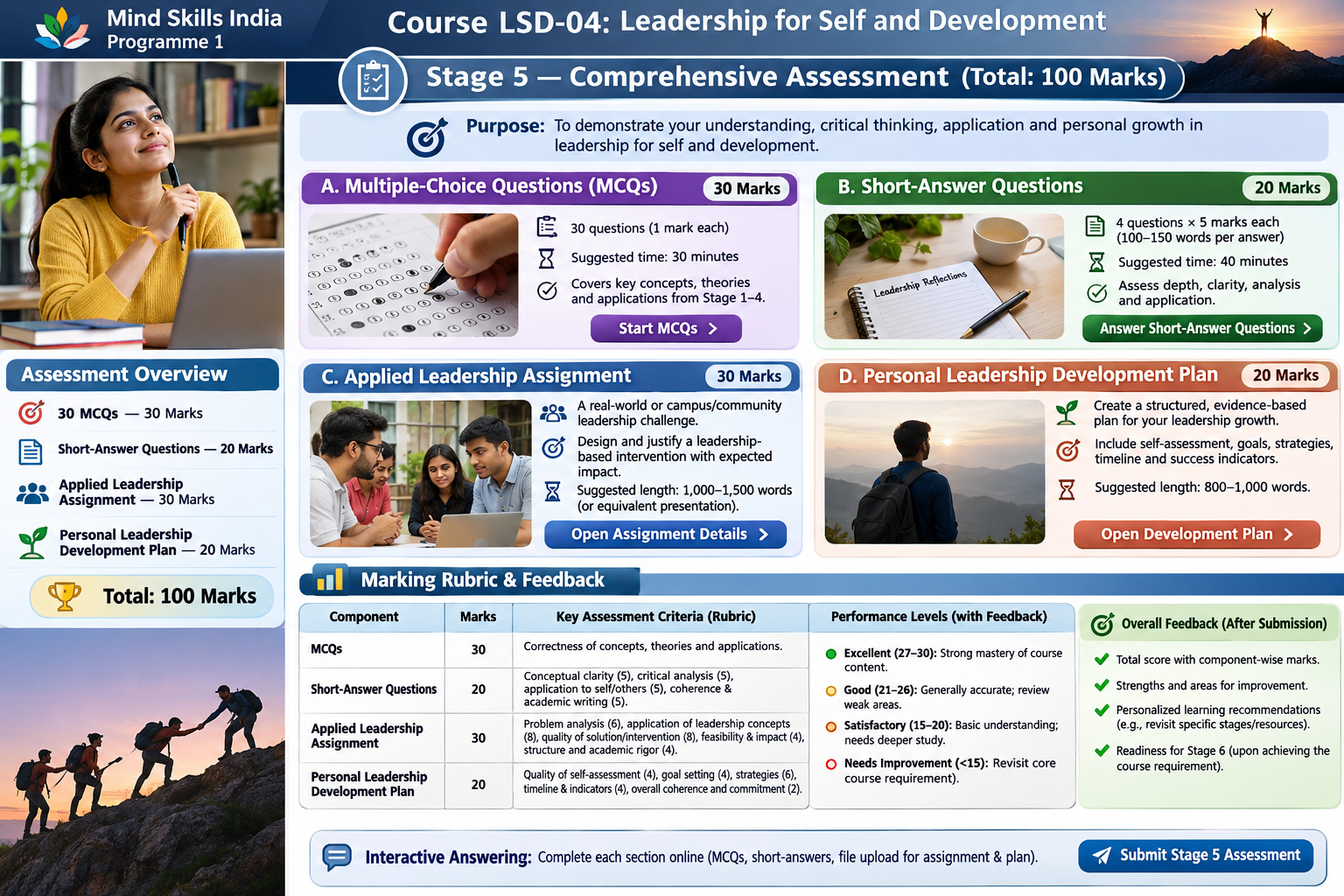
Archived leadership assessment infographic
This graphic shows an earlier course design with a different title and marking scheme. Use the current LSD-04 assessment above for your work.
Stage 6
Completion and action plan
Use your baseline situation to complete this four-week practice plan. For each week, record the action, date, observable result and any feedback you received.
- Week 1. Audit one message for audience and requested action.
- Week 2. Practise paraphrasing before replying.
- Week 3. Make one evidence-based request across teams.
- Week 4. Check understanding and follow-through.
Completion reflection
Record your two assessment scores, a specific behaviour you changed and the evidence of its effect. Identify one practice you will keep and one assumption you will test next month.
References
- Aristotle, Rhetoric.
- French, J. R. P. and Raven, B. (1959), The Bases of Social Power.
- Rogers, C. R. and Farson, R. E. (1957), Active Listening.
LSD-05
Ethical Leadership, Governance and Corporate Values
LSD-05 · Visual guide
An ethical decision pathway
- 1. Establish factsSeparate evidence, assumptions and uncertainty.
- 2. Map dutiesIdentify affected people, obligations and authority.
- 3. Compare optionsConsider fairness, impact and safeguards.
- 4. Record and reviewDocument the reason and escalation route.
Stage 1
Introduction
Recognise ethical tensions, apply fair decision tests and use governance to translate values into accountable practice.
Mind Skills India Signature Line
A value has weight when it can change a decision that would otherwise be convenient.
Before you begin
Choose one real leadership situation you can revisit over the course. Record the current outcome, the people affected and the part of the work you can influence. Keep workplace examples anonymous in group discussions.
Practice framework
- Choose a value and define its observable behaviour
- Map stakeholders for a difficult decision
- Run a decision through the ethics tests
- Review how a target or control affects conduct
Stage 2
Conceptual lessons
Work through the lessons in sequence. Each lesson includes a worked example and a question to check your understanding.
2.1 · Values, rules and ethical judgement
Concept and explanation
Values describe principles an organisation wants to uphold. Rules define required or prohibited behaviour. Ethical judgement applies principles when rules leave room for choice or duties conflict. Consider who is affected, which obligations apply and which options protect both legitimate goals and individual dignity. A decision can comply with an internal procedure and still deserve ethical scrutiny if its consequences are unfair.
Worked example
A manager can assign unpopular weekend duties at discretion. She publishes a rotation and a documented route for exceptions, reducing arbitrary allocation while retaining flexibility for genuine need.
Practice and reflection
Choose one corporate value and write one behaviour that demonstrates it and one tempting shortcut that contradicts it.
What would tell you that your response helped? Write down one observation you could check after the next comparable situation.
Knowledge check
Why translate values into behaviours?
Show the answer
Staff can recognise, discuss and assess observable conduct more consistently than a general aspiration.
Further reading
- Freeman, R. E. (1984), Strategic Management: A Stakeholder Approach.
- Treviño, L. K. (1986), Ethical Decision Making in Organizations: A Person-Situation Interactionist Model.
- Brown, M. E., Treviño, L. K. and Harrison, D. A. (2005), Ethical Leadership: A Social Learning Perspective for Construct Development and Testing.
2.2 · Stakeholders, duties and consequences
Concept and explanation
Stakeholders include people and groups who affect or are affected by an organisational choice. An ethical assessment checks benefits, burdens, rights and power. Consequence-based reasoning examines expected effects. Duty-based reasoning examines obligations that remain relevant even when a shortcut might benefit the majority. Include voices that have little power to challenge the decision.
Worked example
A campus introduces digital-only registration. It reduces processing time but disadvantages applicants who lack reliable access. The team keeps a staffed assistance option and measures its use before deciding the long-term design.
Practice and reflection
Map four stakeholders for a proposed efficiency decision. For each, name a benefit, a burden and a question you would ask.
What would tell you that your response helped? Write down one observation you could check after the next comparable situation.
Knowledge check
Why look beyond those who can approve the decision?
Show the answer
People with little power can carry significant costs. Their experience can expose a problem the approval group cannot see.
Further reading
- Freeman, R. E. (1984), Strategic Management: A Stakeholder Approach.
- Treviño, L. K. (1986), Ethical Decision Making in Organizations: A Person-Situation Interactionist Model.
- Brown, M. E., Treviño, L. K. and Harrison, D. A. (2005), Ethical Leadership: A Social Learning Perspective for Construct Development and Testing.
2.3 · Governance, authority and accountability
Concept and explanation
Governance defines how decisions are directed, challenged and reviewed. Management operates within those arrangements. Good governance clarifies who may approve a decision, what evidence is required, which conflicts must be disclosed and where exceptions go. The record should show the reasoning and who owns follow-up. A control is effective when people know how to use it under time pressure.
Worked example
A procurement committee requires a member with a relationship to a bidder to disclose it and follow the recusal process. An alternate reviewer assesses the bid against documented criteria.
Practice and reflection
Take a recurring decision. Identify the proposer, approver, person who can challenge it, evidence required and exception route.
What would tell you that your response helped? Write down one observation you could check after the next comparable situation.
Knowledge check
What is the benefit of a written decision record?
Show the answer
It supports consistent review, makes authority and reasoning traceable and helps a successor understand the decision.
Further reading
- Freeman, R. E. (1984), Strategic Management: A Stakeholder Approach.
- Treviño, L. K. (1986), Ethical Decision Making in Organizations: A Person-Situation Interactionist Model.
- Brown, M. E., Treviño, L. K. and Harrison, D. A. (2005), Ethical Leadership: A Social Learning Perspective for Construct Development and Testing.
2.4 · Conflicts of interest and speaking up
Concept and explanation
A conflict of interest exists when another interest could interfere with objective judgement. It may be actual, potential or reasonably perceived. Disclosure allows the organisation to manage it through safeguards such as recusal or independent review. Speaking up requires a channel, clarity about confidentiality and protection against retaliation through the applicable procedures. Leaders must respond without public blame or speculative conclusions.
Worked example
A project lead learns a shortlist includes a firm owned by a close relative. She discloses the relationship before scoring and leaves the assessment to the designated reviewers.
Practice and reflection
Write the factual disclosure you would make. Separate verified facts from assumptions and identify who is authorised to receive it.
What would tell you that your response helped? Write down one observation you could check after the next comparable situation.
Knowledge check
Does disclosure resolve every conflict by itself?
Show the answer
No. The authorised decision-maker still needs to decide and record an appropriate safeguard.
Further reading
- Freeman, R. E. (1984), Strategic Management: A Stakeholder Approach.
- Treviño, L. K. (1986), Ethical Decision Making in Organizations: A Person-Situation Interactionist Model.
- Brown, M. E., Treviño, L. K. and Harrison, D. A. (2005), Ethical Leadership: A Social Learning Perspective for Construct Development and Testing.
2.5 · Culture, incentives and ethical drift
Concept and explanation
Ethical drift is the gradual acceptance of exceptions that become normal. It can occur when people are praised for outputs and never questioned about methods. Small repeated workarounds change expectations. Leaders can compare the incentives in a dashboard with the values on the wall, then monitor the unintended effects of targets.
Worked example
A call centre rewards short calls. Agents rush vulnerable customers, who then call back. Management pairs time with first-contact resolution and quality review. Coaching discusses the reason for longer calls rather than penalising every exception.
Practice and reflection
Select one performance target. List two ways it could be gamed and choose a safeguard that would make those behaviours visible.
What would tell you that your response helped? Write down one observation you could check after the next comparable situation.
Knowledge check
What is a sign that a control or incentive needs review?
Show the answer
People repeatedly find it difficult to meet the target and follow the process together, or quality outcomes worsen as the target improves.
Further reading
- Freeman, R. E. (1984), Strategic Management: A Stakeholder Approach.
- Treviño, L. K. (1986), Ethical Decision Making in Organizations: A Person-Situation Interactionist Model.
- Brown, M. E., Treviño, L. K. and Harrison, D. A. (2005), Ethical Leadership: A Social Learning Perspective for Construct Development and Testing.
2.6 · Ethical decisions under pressure
Concept and explanation
An ethical decision process can be short and disciplined. Clarify facts and authority, identify duties and stakeholders, generate lawful and workable alternatives, compare impacts, record the reason and review the outcome. Ask how the decision would be explained to a person affected by it. If evidence is incomplete, identify whether waiting creates harm and which interim safeguards are available.
Worked example
A quality manager learns that a supplier certificate is incomplete hours before dispatch. She verifies the missing evidence, holds affected items and releases only products whose quality checks are documented. She records the basis and escalation.
Practice and reflection
Use the process to write a one-page decision note about a difficult case. Include a reasonable alternative and why you did not choose it.
What would tell you that your response helped? Write down one observation you could check after the next comparable situation.
Knowledge check
What should you record when an urgent decision relies on incomplete information?
Show the answer
Known facts, assumptions, authority, interim safeguards, the review trigger and who will verify the missing facts.
Further reading
- Freeman, R. E. (1984), Strategic Management: A Stakeholder Approach.
- Treviño, L. K. (1986), Ethical Decision Making in Organizations: A Person-Situation Interactionist Model.
- Brown, M. E., Treviño, L. K. and Harrison, D. A. (2005), Ethical Leadership: A Social Learning Perspective for Construct Development and Testing.
Stage 3
Bit Size Papers
Read these brief applications of the source ideas, then compare them with your own workplace experience.
Paper 1
Freeman places affected stakeholders inside strategic reasoning. Map one group that bears a cost but lacks decision power.
Read Freeman, R. E. (1984), Strategic Management: A Stakeholder Approach.
Paper 2
Treviño connects individual judgement to organisational conditions. Examine how targets and peer behaviour change which action feels easy.
Read Treviño, L. K. (1986), Ethical Decision Making in Organizations: A Person-Situation Interactionist Model.
Paper 3
Brown and colleagues emphasise how leaders model and reinforce conduct. Compare the values staff hear with the behaviour they see recognised.
Read Brown, M. E., Treviño, L. K. and Harrison, D. A. (2005), Ethical Leadership: A Social Learning Perspective for Construct Development and Testing.
Stage 4
Practical case
Fictional case
The sales target and the unsigned consent
An employee is asked to record a sale before customer consent is complete to meet a month-end target. A manager suggests correcting it on Monday. The employee wants to protect the customer and avoid unfair treatment by the team.
Discussion task
Explain the immediate decision, what evidence to record and which authorised escalation path to use.
Suggested approach
Decline to record completion without consent. Preserve the factual record in the approved system, report through the proper channel and review how target pressure contributed to the instruction.
Stage 5
Assessment
Six short questions
Answer each question in your own words. Award 2 points for a complete answer, 1 for a partly correct answer and 0 if the principle is missing.
- Why translate values into behaviours?
- Why look beyond those who can approve the decision?
- What is the benefit of a written decision record?
- Does disclosure resolve every conflict by itself?
- What is a sign that a control or incentive needs review?
- What should you record when an urgent decision relies on incomplete information?
Answer guide · 12 points
- Staff can recognise, discuss and assess observable conduct more consistently than a general aspiration.
- People with little power can carry significant costs. Their experience can expose a problem the approval group cannot see.
- It supports consistent review, makes authority and reasoning traceable and helps a successor understand the decision.
- No. The authorised decision-maker still needs to decide and record an appropriate safeguard.
- People repeatedly find it difficult to meet the target and follow the process together, or quality outcomes worsen as the target improves.
- Known facts, assumptions, authority, interim safeguards, the review trigger and who will verify the missing facts.
Applied assessment
A supplier offers a benefit to a person who will score its bid. Write a decision note showing who is affected, what the scorer should do and how the process remains fair.
Score your response from 0 to 2 on each criterion: accurate concept, use of case evidence, defensible action and verifiable follow-up. Use the guide to improve your response.
Model response · 8 points
Record the facts and competing interest, decline or disclose as the applicable policy requires, use an authorised safeguard and protect consistent criteria and independent review.
Stage 6
Completion and action plan
Use your baseline situation to complete this four-week practice plan. For each week, record the action, date, observable result and any feedback you received.
- Week 1. Choose a value and define its observable behaviour.
- Week 2. Map stakeholders for a difficult decision.
- Week 3. Run a decision through the ethics tests.
- Week 4. Review how a target or control affects conduct.
Completion reflection
Record your two assessment scores, a specific behaviour you changed and the evidence of its effect. Identify one practice you will keep and one assumption you will test next month.
References
- Freeman, R. E. (1984), Strategic Management: A Stakeholder Approach.
- Treviño, L. K. (1986), Ethical Decision Making in Organizations: A Person-Situation Interactionist Model.
- Brown, M. E., Treviño, L. K. and Harrison, D. A. (2005), Ethical Leadership: A Social Learning Perspective for Construct Development and Testing.
LSD-06
Leading Organisational Change and Transformation
LSD-06 · Visual guide
From change idea to sustained use
- 1. DiagnoseMap readiness, workflow and barriers.
- 2. DesignInvolve sponsors and people doing the work.
- 3. PilotTrack correct adoption, quality and side effects.
- 4. EmbedAssign ownership, training and review.
Stage 1
Introduction
Diagnose the need for change, support people through transition and use adoption evidence to guide implementation.
Mind Skills India Signature Line
Change takes hold when people can do the new work reliably on an ordinary day.
Before you begin
Choose one real leadership situation you can revisit over the course. Record the current outcome, the people affected and the part of the work you can influence. Keep workplace examples anonymous in group discussions.
Practice framework
- Map the current and intended workflow
- Consult two affected groups and remove one barrier
- Pilot a new practice with a fallback
- Review adoption, quality and unintended effects
Stage 2
Conceptual lessons
Work through the lessons in sequence. Each lesson includes a worked example and a question to check your understanding.
2.1 · Change, transition and transformation
Concept and explanation
An organisational change alters a process, structure or tool. Transition is the adjustment people make as they learn new expectations. Transformation changes several connected parts of how an organisation creates value. Installing booking software changes a tool. Redesigning who allocates appointments, how clinicians share capacity and how patients get support can change the operating model. Diagnose the scope before choosing a response.
Worked example
A retailer introduces online returns. Its systems team sees a form redesign. Store staff also need new decision rights, inventory steps and handling rules. The sponsor maps these changes before setting the launch date.
Practice and reflection
Describe one change in terms of what starts, stops and continues for two affected roles.
What would tell you that your response helped? Write down one observation you could check after the next comparable situation.
Knowledge check
Why can a technically successful launch still fail?
Show the answer
People may lack skills, time, authority or incentives to perform the new work reliably.
Further reading
- Lewin, K. (1947), Frontiers in Group Dynamics.
- Kotter, J. P. (1996), Leading Change.
- Rogers, E. M. (2003), Diffusion of Innovations, fifth edition.
2.2 · Readiness, forces and stakeholder analysis
Concept and explanation
Readiness is the capacity and willingness to carry out a specific change. Analyse factors that drive the change and those that restrain it. Resistance can be useful information about workload, trust, role loss or a technical dependency. A stakeholder map names whose approval, expertise and adoption matter. Validate the map with people who do the work.
Worked example
A distributor expects drivers to use an app at every drop-off. Drivers report dead zones and time lost to login. An offline option and simpler authentication address the barriers more directly than a second motivational briefing.
Practice and reflection
Identify three forces helping the change and three restraining it. Separate one concern based on evidence from one assumption you should test.
What would tell you that your response helped? Write down one observation you could check after the next comparable situation.
Knowledge check
What makes readiness different from enthusiasm?
Show the answer
Readiness includes the resources, skills and decision rights needed to act, along with willingness.
Further reading
- Lewin, K. (1947), Frontiers in Group Dynamics.
- Kotter, J. P. (1996), Leading Change.
- Rogers, E. M. (2003), Diffusion of Innovations, fifth edition.
2.3 · Sponsorship, coalition and communication
Concept and explanation
A sponsor makes decisions and secures resources. A coalition brings together people with influence and practical knowledge. A local change lead translates direction into work routines and brings evidence back to the sponsor. Explain the need, intended outcome and support in terms each group can use. Create a route for staff to report problems and receive a response.
Worked example
An operations director sponsors a new quality process. Shift leads teach the procedure and collect examples of ambiguities. The director adjusts staffing and resolves disagreements across sites.
Practice and reflection
Name a sponsor, two local leads and a person likely to be overlooked. Write the decision or input expected from each.
What would tell you that your response helped? Write down one observation you could check after the next comparable situation.
Knowledge check
What is one concrete way a sponsor can demonstrate commitment?
Show the answer
Allocate resources, resolve a cross-team obstacle or change an incentive that conflicts with the new practice.
Further reading
- Lewin, K. (1947), Frontiers in Group Dynamics.
- Kotter, J. P. (1996), Leading Change.
- Rogers, E. M. (2003), Diffusion of Innovations, fifth edition.
2.4 · Pilots, adoption and implementation
Concept and explanation
A pilot is a bounded test with a defined group, purpose, duration and decision rule. Baseline data allow a comparison. Adoption measures distinguish people who attended training from people who use the new process correctly. Outcome measures ask whether the work improved. Safeguards track errors, fairness and workload. Give the team a fallback if the pilot creates unacceptable harm.
Worked example
A university tests online approvals in one department. It measures requests completed in the system, turnaround time and errors. It keeps a manual exception route for cases the pilot cannot handle.
Practice and reflection
Design a two-week pilot. State the baseline, adoption measure, quality safeguard, owner and scale or pause criteria.
What would tell you that your response helped? Write down one observation you could check after the next comparable situation.
Knowledge check
Why is training completion an incomplete adoption measure?
Show the answer
It records attendance or completion. It does not show correct use of the new practice in real work.
Further reading
- Lewin, K. (1947), Frontiers in Group Dynamics.
- Kotter, J. P. (1996), Leading Change.
- Rogers, E. M. (2003), Diffusion of Innovations, fifth edition.
2.5 · Responding to setbacks and resistance
Concept and explanation
A setback can come from weak design, scarce resources or understandable loss. Classify the issue before acting. An information gap can be addressed with a demonstration. A capability gap needs coached practice. A valid objection may call for redesign. Unresolved conflict about duties needs a decision from the responsible leader. Record the response so staff can see what happened to their input.
Worked example
Frontline employees complain that a new form creates extra work. Observation shows they enter the same data twice. The project team removes the duplicate field and retests time and error rates.
Practice and reflection
Choose one objection. Ask for an example, identify its cause and decide whether to clarify, support, redesign or escalate.
What would tell you that your response helped? Write down one observation you could check after the next comparable situation.
Knowledge check
What is a useful question when adoption drops after the first week?
Show the answer
Ask where the workflow becomes difficult during an ordinary shift and observe one real transaction.
Further reading
- Lewin, K. (1947), Frontiers in Group Dynamics.
- Kotter, J. P. (1996), Leading Change.
- Rogers, E. M. (2003), Diffusion of Innovations, fifth edition.
2.6 · Embedding and sustaining transformation
Concept and explanation
A change becomes routine when role descriptions, training, measures and support reinforce it. Build review into normal management rather than relying on the launch team. Retire old processes after replacement controls and exceptions are verified. Document what the team learned, the conditions that enabled success and the problems that need monitoring.
Worked example
A service team moves from individual spreadsheets to a shared register. After it verifies reporting and fallback, it archives the old files, updates induction and gives the register a permanent process owner.
Practice and reflection
Write a handover plan with a new process owner, a training update and a 30-day review date.
What would tell you that your response helped? Write down one observation you could check after the next comparable situation.
Knowledge check
What evidence shows that a change is sustained?
Show the answer
People use the new practice correctly across shifts, quality holds and a responsible owner responds when performance slips.
Further reading
- Lewin, K. (1947), Frontiers in Group Dynamics.
- Kotter, J. P. (1996), Leading Change.
- Rogers, E. M. (2003), Diffusion of Innovations, fifth edition.
Stage 3
Bit Size Papers
Read these brief applications of the source ideas, then compare them with your own workplace experience.
Paper 1
Lewin’s work on group dynamics invites analysis of forces that sustain current behaviour. Identify one obstacle you can reduce rather than simply increasing pressure.
Read Lewin, K. (1947), Frontiers in Group Dynamics.
Paper 2
Kotter describes building a coalition and sustaining momentum. Identify who must lead locally for a change to work outside the sponsor’s office.
Read Kotter, J. P. (1996), Leading Change.
Paper 3
Rogers examines how innovations spread through social systems. Ask how staff can observe, try and evaluate a new practice safely.
Read Rogers, E. M. (2003), Diffusion of Innovations, fifth edition.
Stage 4
Practical case
Fictional case
A hospital redesigns appointment booking
A hospital will introduce central scheduling. Clinics fear losing flexibility, and the booking team expects more calls. A pilot shows shorter wait times but more rescheduled visits for one specialty.
Discussion task
Choose whether to expand, adapt or pause. Explain who will decide and what evidence you need.
Suggested approach
Adapt the pilot before expansion. Check how specialty appointment durations and urgent slots are handled, then compare wait time and reschedules. Keep an exception route and involve clinic coordinators in redesign.
Stage 5
Assessment
Six short questions
Answer each question in your own words. Award 2 points for a complete answer, 1 for a partly correct answer and 0 if the principle is missing.
- Why can a technically successful launch still fail?
- What makes readiness different from enthusiasm?
- What is one concrete way a sponsor can demonstrate commitment?
- Why is training completion an incomplete adoption measure?
- What is a useful question when adoption drops after the first week?
- What evidence shows that a change is sustained?
Answer guide · 12 points
- People may lack skills, time, authority or incentives to perform the new work reliably.
- Readiness includes the resources, skills and decision rights needed to act, along with willingness.
- Allocate resources, resolve a cross-team obstacle or change an incentive that conflicts with the new practice.
- It records attendance or completion. It does not show correct use of the new practice in real work.
- Ask where the workflow becomes difficult during an ordinary shift and observe one real transaction.
- People use the new practice correctly across shifts, quality holds and a responsible owner responds when performance slips.
Applied assessment
A pilot reduces processing time but errors rise. Decide whether to scale, adapt or pause. Propose an evidence-based review.
Score your response from 0 to 2 on each criterion: accurate concept, use of case evidence, defensible action and verifiable follow-up. Use the guide to improve your response.
Model response · 8 points
Check error severity and source. Pause or adapt where necessary, retain a fallback and compare time, correct use and errors against baseline before deciding.
Stage 6
Completion and action plan
Use your baseline situation to complete this four-week practice plan. For each week, record the action, date, observable result and any feedback you received.
- Week 1. Map the current and intended workflow.
- Week 2. Consult two affected groups and remove one barrier.
- Week 3. Pilot a new practice with a fallback.
- Week 4. Review adoption, quality and unintended effects.
Completion reflection
Record your two assessment scores, a specific behaviour you changed and the evidence of its effect. Identify one practice you will keep and one assumption you will test next month.
References
- Lewin, K. (1947), Frontiers in Group Dynamics.
- Kotter, J. P. (1996), Leading Change.
- Rogers, E. M. (2003), Diffusion of Innovations, fifth edition.
LSD-07
Conflict Resolution, Negotiation and Crisis Leadership
LSD-07 · Visual guide
Conflict and crisis response
- 1. StabiliseProtect people and verify immediate risks.
- 2. ClarifySeparate facts, interests and positions.
- 3. AgreeChoose a workable action and assign ownership.
- 4. LearnReview the outcome and test the agreed change.
Stage 1
Introduction
Diagnose conflict, negotiate workable agreements and lead coordinated action during uncertainty and pressure.
Mind Skills India Signature Line
A difficult conversation improves when the facts become clearer and each party knows what happens next.
Before you begin
Choose one real leadership situation you can revisit over the course. Record the current outcome, the people affected and the part of the work you can influence. Keep workplace examples anonymous in group discussions.
Practice framework
- Identify a conflict type and separate facts from interpretations
- Prepare interests, criteria and a fallback for one negotiation
- Practise a crisis update with a check-back
- Write and review an agreement with owners and dates
Stage 2
Conceptual lessons
Work through the lessons in sequence. Each lesson includes a worked example and a question to check your understanding.
2.1 · Diagnosing the conflict
Concept and explanation
Task conflict concerns what should be done. Process conflict concerns who should do it and how. Relationship conflict concerns personal tension. A single dispute can contain all three. Identify the issue, behaviour and impact before choosing a response. A structural conflict such as incompatible targets cannot be solved by asking people to be more agreeable.
Worked example
Sales wants faster dispatch and quality wants complete checks. Their targets reward opposing behaviours. The manager creates a shared release measure and a defined exception route, then asks the teams to resolve the remaining workflow issue.
Practice and reflection
Write the disagreement as a neutral sentence both parties might accept. Identify one incentive or resource constraint behind it.
What would tell you that your response helped? Write down one observation you could check after the next comparable situation.
Knowledge check
Why diagnose the conflict before mediating it?
Show the answer
The best intervention depends on whether the cause is a factual disagreement, unclear roles, incompatible goals or interpersonal harm.
Further reading
- Fisher, R., Ury, W. and Patton, B. (1991), Getting to Yes, second edition.
- Thomas, K. W. (1992), Conflict and Conflict Management: Reflections and Update.
- Weick, K. E. (1993), The Collapse of Sensemaking in Organizations: The Mann Gulch Disaster.
2.2 · Choosing how to respond
Concept and explanation
Conflict modes vary in the degree of assertiveness and cooperation. An urgent safety issue may require a firm decision. A minor dispute can warrant temporary deferral. Compromise may save time when parties can give up part of their requests. Collaboration is useful when the interests are important and solutions can be combined. The mode should fit urgency, stakes, relationships and authority.
Worked example
Two teams compete for one meeting room. A quick compromise works for this week. A repeated problem warrants a collaboration session about schedules, equipment and access to another room.
Practice and reflection
Choose two different responses to a conflict, then state what would make each appropriate.
What would tell you that your response helped? Write down one observation you could check after the next comparable situation.
Knowledge check
When can deferral be constructive?
Show the answer
When a short pause allows facts, authority or emotional readiness to improve, with a time and owner for reopening the issue.
Further reading
- Fisher, R., Ury, W. and Patton, B. (1991), Getting to Yes, second edition.
- Thomas, K. W. (1992), Conflict and Conflict Management: Reflections and Update.
- Weick, K. E. (1993), The Collapse of Sensemaking in Organizations: The Mann Gulch Disaster.
2.3 · Negotiating interests, options and alternatives
Concept and explanation
A position states what a party asks for. An interest explains why it matters. Define your best alternative to a negotiated agreement, often called BATNA, before committing. Generate options that meet interests, then compare them against objective criteria such as capacity or a service standard. Record conditional offers explicitly so people know what depends on what.
Worked example
A supplier asks for a longer payment period. The buyer wants predictable delivery. An agreement might adjust the delivery schedule, use smaller batches or tie revised payment timing to verified milestones, subject to authority.
Practice and reflection
For one negotiation, write both parties’ likely interests, two options, a fair criterion and your fallback.
What would tell you that your response helped? Write down one observation you could check after the next comparable situation.
Knowledge check
What is the difference between a fallback and a preferred agreement?
Show the answer
The fallback is what you can do if no agreement is reached. It helps you assess whether an offer improves on your alternative.
Further reading
- Fisher, R., Ury, W. and Patton, B. (1991), Getting to Yes, second edition.
- Thomas, K. W. (1992), Conflict and Conflict Management: Reflections and Update.
- Weick, K. E. (1993), The Collapse of Sensemaking in Organizations: The Mann Gulch Disaster.
2.4 · Mediation and difficult conversations
Concept and explanation
Mediation helps parties hear each other and develop a workable agreement. The facilitator sets ground rules, gives each party a turn, summarises the issues and tests options. Use examples of behaviour rather than labels. Some issues need formal investigation or authority beyond a mediation conversation. Where an agreement is appropriate, record actions, dates and how a breach will be handled.
Worked example
Two faculty coordinators argue over exam invigilation. A mediator identifies the staffing constraint, separates it from earlier grievances and helps them agree a rotation with exceptions approved by the department head.
Practice and reflection
Role-play a five-minute opening. Set the scope, ask for each perspective and write one neutral summary.
What would tell you that your response helped? Write down one observation you could check after the next comparable situation.
Knowledge check
When is informal mediation insufficient?
Show the answer
When allegations, safety issues or formal duties require an authorised investigation, reporting or protective action.
Further reading
- Fisher, R., Ury, W. and Patton, B. (1991), Getting to Yes, second edition.
- Thomas, K. W. (1992), Conflict and Conflict Management: Reflections and Update.
- Weick, K. E. (1993), The Collapse of Sensemaking in Organizations: The Mann Gulch Disaster.
2.5 · Crisis leadership and first-hour priorities
Concept and explanation
A crisis compresses time and increases uncertainty. Establish an incident lead, protect people, verify what is affected and set a rhythm for updates. Separate confirmed facts from working assumptions. Give each action a named owner and deadline. Choose reversible actions when available, and escalate rapidly when action exceeds delegated authority or risks increase.
Worked example
A warehouse loses power during dispatch. The incident lead checks personnel safety, identifies temperature-sensitive stock, confirms generator capacity and assigns updates. The customer team communicates what is known and when the next update will arrive.
Practice and reflection
Prepare a 60-second update with the event, impact, current action, unknowns and next update time.
What would tell you that your response helped? Write down one observation you could check after the next comparable situation.
Knowledge check
Why include unknowns in an incident update?
Show the answer
It prevents guesses from becoming accepted facts and helps the team decide what to verify next.
Further reading
- Fisher, R., Ury, W. and Patton, B. (1991), Getting to Yes, second edition.
- Thomas, K. W. (1992), Conflict and Conflict Management: Reflections and Update.
- Weick, K. E. (1993), The Collapse of Sensemaking in Organizations: The Mann Gulch Disaster.
2.6 · Recovery, accountability and learning
Concept and explanation
Recovery restores service and deals with remaining harms. An after-action review reconstructs what was expected, what occurred, why it differed and what will change. Separate the immediate response from investigation of accountability where appropriate. Actions need owners, dates and verification. Rehearse the revised process so that written lessons become usable behaviour.
Worked example
After a delayed response to an outage, the team discovers conflicting contact lists. It creates one maintained list, names an owner and tests the escalation path on a different shift.
Practice and reflection
Write a five-line after-action note and one follow-up test that would demonstrate improvement.
What would tell you that your response helped? Write down one observation you could check after the next comparable situation.
Knowledge check
What makes a lesson from a crisis actionable?
Show the answer
A specific change, assigned owner, due date and test showing that the weakness has been addressed.
Further reading
- Fisher, R., Ury, W. and Patton, B. (1991), Getting to Yes, second edition.
- Thomas, K. W. (1992), Conflict and Conflict Management: Reflections and Update.
- Weick, K. E. (1993), The Collapse of Sensemaking in Organizations: The Mann Gulch Disaster.
Stage 3
Bit Size Papers
Read these brief applications of the source ideas, then compare them with your own workplace experience.
Paper 1
Fisher, Ury and Patton distinguish interests from positions. Write the interest beneath an apparently fixed demand.
Read Fisher, R., Ury, W. and Patton, B. (1991), Getting to Yes, second edition.
Paper 2
Thomas examines conflict behaviour through assertiveness and cooperation. Identify where delay, compromise or collaboration is proportionate.
Read Thomas, K. W. (1992), Conflict and Conflict Management: Reflections and Update.
Paper 3
Weick’s analysis shows how shared understanding can break down in crisis. Design one check-back that confirms the team is acting on the same facts.
Read Weick, K. E. (1993), The Collapse of Sensemaking in Organizations: The Mann Gulch Disaster.
Stage 4
Practical case
Fictional case
An outage strains a supplier relationship
A software service outage stops transactions. The supplier wants time to diagnose. Operations wants an immediate rollback. The customer team needs a clear update and managers disagree about the cause.
Discussion task
Set the first-hour priorities, the decision authority and an escalation time. Plan a negotiation for the service review after recovery.
Suggested approach
Name an incident lead. Assess affected functions, rollback risk and customer impact, then act through authorised controls. Share facts and next update time. After recovery negotiate response expectations using a common timeline and objective criteria.
Stage 5
Assessment
Six short questions
Answer each question in your own words. Award 2 points for a complete answer, 1 for a partly correct answer and 0 if the principle is missing.
- Why diagnose the conflict before mediating it?
- When can deferral be constructive?
- What is the difference between a fallback and a preferred agreement?
- When is informal mediation insufficient?
- Why include unknowns in an incident update?
- What makes a lesson from a crisis actionable?
Answer guide · 12 points
- The best intervention depends on whether the cause is a factual disagreement, unclear roles, incompatible goals or interpersonal harm.
- When a short pause allows facts, authority or emotional readiness to improve, with a time and owner for reopening the issue.
- The fallback is what you can do if no agreement is reached. It helps you assess whether an offer improves on your alternative.
- When allegations, safety issues or formal duties require an authorised investigation, reporting or protective action.
- It prevents guesses from becoming accepted facts and helps the team decide what to verify next.
- A specific change, assigned owner, due date and test showing that the weakness has been addressed.
Applied assessment
Two functions disagree during a disruption. Write a first-hour update and outline how you would negotiate a permanent change after recovery.
Score your response from 0 to 2 on each criterion: accurate concept, use of case evidence, defensible action and verifiable follow-up. Use the guide to improve your response.
Model response · 8 points
Separate known facts and unknowns, assign incident authority and an update time, then clarify each interest, objective criteria, alternatives and how any agreement will be verified.
Stage 6
Completion and action plan
Use your baseline situation to complete this four-week practice plan. For each week, record the action, date, observable result and any feedback you received.
- Week 1. Identify a conflict type and separate facts from interpretations.
- Week 2. Prepare interests, criteria and a fallback for one negotiation.
- Week 3. Practise a crisis update with a check-back.
- Week 4. Write and review an agreement with owners and dates.
Completion reflection
Record your two assessment scores, a specific behaviour you changed and the evidence of its effect. Identify one practice you will keep and one assumption you will test next month.
References
- Fisher, R., Ury, W. and Patton, B. (1991), Getting to Yes, second edition.
- Thomas, K. W. (1992), Conflict and Conflict Management: Reflections and Update.
- Weick, K. E. (1993), The Collapse of Sensemaking in Organizations: The Mann Gulch Disaster.
LSD-08
Building High-Performance Teams and Leadership Culture
LSD-08 · Visual guide
Building a high-performance team
- 1. AlignDefine a shared purpose and result.
- 2. CoordinateClarify roles, decisions and handovers.
- 3. Build trustInvite challenge and follow through.
- 4. ImproveReview outcomes and test a better routine.
Stage 1
Introduction
Design clear team conditions, build trust and coordination, and sustain performance without sacrificing learning or accountability.
Mind Skills India Signature Line
The strength of a team shows in what its members can coordinate without waiting for the leader.
Before you begin
Choose one real leadership situation you can revisit over the course. Record the current outcome, the people affected and the part of the work you can influence. Keep workplace examples anonymous in group discussions.
Practice framework
- Draft a one-page team charter
- Clarify decision rights for a recurring handover
- Run one feedback or learning routine
- Review team outcomes and adjust a norm
Stage 2
Conceptual lessons
Work through the lessons in sequence. Each lesson includes a worked example and a question to check your understanding.
2.1 · Team purpose and interdependence
Concept and explanation
A team performs work that requires coordinated contribution towards a shared outcome. Members may have different expertise, but their tasks depend on one another. A team charter states purpose, members, authority and operating norms. It should explain how success is judged at the whole-team level. Individual output still matters when it enables that shared result.
Worked example
In an emergency department, triage, clinical care and discharge depend on handovers. A shared objective for safe patient flow focuses attention on the connection between roles.
Practice and reflection
Write a team purpose and one sentence explaining why the work needs a team rather than parallel individual effort.
What would tell you that your response helped? Write down one observation you could check after the next comparable situation.
Knowledge check
What is a sign that a group lacks a shared outcome?
Show the answer
Members meet their own targets while the end-to-end outcome deteriorates or falls between roles.
Further reading
- Tuckman, B. W. (1965), Developmental Sequence in Small Groups.
- Hackman, J. R. (2002), Leading Teams: Setting the Stage for Great Performances.
- Edmondson, A. C. (1999), Psychological Safety and Learning Behavior in Work Teams.
2.2 · Roles, decision rights and handovers
Concept and explanation
Role clarity describes what each person owns and how they coordinate. Decision rights specify who makes a decision, whom to consult and who needs to know. A handover should include status, risk, next action and ownership. When several people are responsible in a general sense, define one person accountable for bringing the work to closure.
Worked example
A software team hands defects from support to engineering. A template records expected behaviour, observed behaviour and urgency. A named incident owner updates the reporter until closure.
Practice and reflection
Map a current handover. Specify the information required, who accepts it and when responsibility changes.
What would tell you that your response helped? Write down one observation you could check after the next comparable situation.
Knowledge check
What should happen when a handover is incomplete?
Show the answer
The receiving role should request the missing information or escalate through the agreed route, with clear interim ownership.
Further reading
- Tuckman, B. W. (1965), Developmental Sequence in Small Groups.
- Hackman, J. R. (2002), Leading Teams: Setting the Stage for Great Performances.
- Edmondson, A. C. (1999), Psychological Safety and Learning Behavior in Work Teams.
2.3 · Team development and norms
Concept and explanation
Teams face different developmental challenges: orientation, disagreement, agreement on norms and effective coordination. Development is rarely a straight sequence. New membership or a changed task can reopen an earlier issue. Explicit norms help people work through friction. Specify when decisions are made, how disagreement is handled and how exceptions are raised.
Worked example
A design team adds a compliance reviewer and begins repeating debates after decisions. It agrees to record the rationale and reopen a choice only when new evidence or a defined risk emerges.
Practice and reflection
Name one repeated friction point. Propose a behaviour the team can practise for two weeks and review together.
What would tell you that your response helped? Write down one observation you could check after the next comparable situation.
Knowledge check
Why revisit norms after a team changes membership?
Show the answer
New roles and expectations may make previously implicit agreements unclear or inadequate.
Further reading
- Tuckman, B. W. (1965), Developmental Sequence in Small Groups.
- Hackman, J. R. (2002), Leading Teams: Setting the Stage for Great Performances.
- Edmondson, A. C. (1999), Psychological Safety and Learning Behavior in Work Teams.
2.4 · Trust, candour and psychological safety
Concept and explanation
Trust concerns willingness to rely on others. Psychological safety concerns whether team members believe speaking up is safe in the group. Reliability, fairness and transparent follow-through support trust. A leader supports candour by acknowledging uncertainty, asking for concerns and responding constructively to bad news. Performance standards give the conversation purpose and direction.
Worked example
A project lead asks the newest analyst to describe where a forecast could fail, gives time to prepare and records a risk the analyst identifies. Later she reports how the risk was handled.
Practice and reflection
Before closing your next decision, ask for one concern and record what you do with it.
What would tell you that your response helped? Write down one observation you could check after the next comparable situation.
Knowledge check
Can a team be candid and demanding at the same time?
Show the answer
Yes. People can speak openly about errors and still be expected to correct them and meet agreed standards.
Further reading
- Tuckman, B. W. (1965), Developmental Sequence in Small Groups.
- Hackman, J. R. (2002), Leading Teams: Setting the Stage for Great Performances.
- Edmondson, A. C. (1999), Psychological Safety and Learning Behavior in Work Teams.
2.5 · Coaching, delegation and accountability
Concept and explanation
Delegation assigns an outcome and the authority needed to pursue it. Coaching helps the person build judgement through questions, practice and feedback. Set guardrails and review points according to risk and experience. Accountability includes both the assignee’s follow-through and the leader’s duty to provide information, time and support.
Worked example
A branch manager delegates a service review to an assistant manager. She specifies the evidence and decision limits, meets after the first sample and lets the assistant propose improvements.
Practice and reflection
Write a delegation agreement with outcome, authority, guardrails, resources and review date.
What would tell you that your response helped? Write down one observation you could check after the next comparable situation.
Knowledge check
How does a review point support delegation?
Show the answer
It provides a scheduled chance to learn or intervene while leaving responsibility with the assignee between reviews.
Further reading
- Tuckman, B. W. (1965), Developmental Sequence in Small Groups.
- Hackman, J. R. (2002), Leading Teams: Setting the Stage for Great Performances.
- Edmondson, A. C. (1999), Psychological Safety and Learning Behavior in Work Teams.
2.6 · Team culture and continuous improvement
Concept and explanation
Culture is expressed through repeated practices, stories and rewards. A retrospective asks what helped, what hindered and what to change in the next cycle. Use evidence from outcomes and from how people experienced the process. Choose one change the team can test. A small improvement sustained over several cycles is more informative than a long list with no owners.
Worked example
A retail team sees rising sales alongside rising returns. The team compares patterns, tests a better product explanation and checks whether returns fall without suppressing legitimate complaints.
Practice and reflection
Run a 20-minute retrospective and select one action with an owner, success measure and date.
What would tell you that your response helped? Write down one observation you could check after the next comparable situation.
Knowledge check
Why use both performance and quality measures?
Show the answer
A single outcome can improve while an important cost grows elsewhere. The pair helps reveal the trade-off.
Further reading
- Tuckman, B. W. (1965), Developmental Sequence in Small Groups.
- Hackman, J. R. (2002), Leading Teams: Setting the Stage for Great Performances.
- Edmondson, A. C. (1999), Psychological Safety and Learning Behavior in Work Teams.
Stage 3
Bit Size Papers
Read these brief applications of the source ideas, then compare them with your own workplace experience.
Paper 1
Tuckman describes recurring challenges as groups develop. Use the stages to ask what the team needs, while recognising that development can move back and forth.
Read Tuckman, B. W. (1965), Developmental Sequence in Small Groups.
Paper 2
Hackman emphasises conditions for team effectiveness. Examine whether the task, boundaries and organisational support allow this team to succeed.
Read Hackman, J. R. (2002), Leading Teams: Setting the Stage for Great Performances.
Paper 3
Edmondson links psychological safety to learning behaviour in a manufacturing field study. Consider what happens when a person challenges the leader’s interpretation of a problem.
Read Edmondson, A. C. (1999), Psychological Safety and Learning Behavior in Work Teams.
Stage 4
Practical case
Fictional case
A cross-functional service team stalls
A new team brings together sales, fulfilment and support. Each group meets its own target, but customers repeat their information and issues remain unresolved. Meetings focus on defending functions.
Discussion task
Design a shared purpose, two measures and a handover rule. Describe a first retrospective.
Suggested approach
Define success as resolution without avoidable repeat contact. Track resolution time and repeat contacts, with quality sampling. Assign a single case owner and review one failed handover using the facts.
Stage 5
Assessment
Six short questions
Answer each question in your own words. Award 2 points for a complete answer, 1 for a partly correct answer and 0 if the principle is missing.
- What is a sign that a group lacks a shared outcome?
- What should happen when a handover is incomplete?
- Why revisit norms after a team changes membership?
- Can a team be candid and demanding at the same time?
- How does a review point support delegation?
- Why use both performance and quality measures?
Answer guide · 12 points
- Members meet their own targets while the end-to-end outcome deteriorates or falls between roles.
- The receiving role should request the missing information or escalate through the agreed route, with clear interim ownership.
- New roles and expectations may make previously implicit agreements unclear or inadequate.
- Yes. People can speak openly about errors and still be expected to correct them and meet agreed standards.
- It provides a scheduled chance to learn or intervene while leaving responsibility with the assignee between reviews.
- A single outcome can improve while an important cost grows elsewhere. The pair helps reveal the trade-off.
Applied assessment
A cross-functional team meets individual targets but misses the customer outcome. Write a charter correction and propose two measures and a feedback routine.
Score your response from 0 to 2 on each criterion: accurate concept, use of case evidence, defensible action and verifiable follow-up. Use the guide to improve your response.
Model response · 8 points
Name a shared outcome and case owner. Pair a result measure with a quality safeguard and review a concrete handover example in the next retrospective.
Stage 6
Completion and action plan
Use your baseline situation to complete this four-week practice plan. For each week, record the action, date, observable result and any feedback you received.
- Week 1. Draft a one-page team charter.
- Week 2. Clarify decision rights for a recurring handover.
- Week 3. Run one feedback or learning routine.
- Week 4. Review team outcomes and adjust a norm.
Completion reflection
Record your two assessment scores, a specific behaviour you changed and the evidence of its effect. Identify one practice you will keep and one assumption you will test next month.
References
- Tuckman, B. W. (1965), Developmental Sequence in Small Groups.
- Hackman, J. R. (2002), Leading Teams: Setting the Stage for Great Performances.
- Edmondson, A. C. (1999), Psychological Safety and Learning Behavior in Work Teams.
LSD-09
Decision-Making Under Uncertainty and Risk
LSD-09 · Visual guide
Decision-making under uncertainty
- 1. FrameSet the decision, criteria and constraints.
- 2. CompareTest scenarios, probabilities and downside.
- 3. ChallengeSeek dissent and check for bias.
- 4. RevisitRecord assumptions and review triggers.
Stage 1
Introduction
Frame decisions, compare options and consequences, recognise bias and set triggers for reviewing choices as evidence changes.
Mind Skills India Signature Line
Good judgement records what it knows, what it assumes and what would make it change its mind.
Before you begin
Choose one real leadership situation you can revisit over the course. Record the current outcome, the people affected and the part of the work you can influence. Keep workplace examples anonymous in group discussions.
Practice framework
- Write a decision statement and rank criteria
- Build scenarios and test one assumption
- Run a premortem and record dissent
- Compare result with prediction and update one rule
Stage 2
Conceptual lessons
Work through the lessons in sequence. Each lesson includes a worked example and a question to check your understanding.
2.1 · Framing the decision and its criteria
Concept and explanation
A decision frame names the choice, the decision-maker, the deadline and the outcome sought. Define criteria before becoming attached to an option. Separate mandatory conditions from trade-offs. A choice about replacing a device may be about service continuity, availability of support and lifetime cost. Framing it solely as a purchase price can hide the actual objective.
Worked example
A college compares two examination platforms. It treats accessibility and data protection as minimum requirements. It then compares implementation time, user effort and total cost among options that meet them.
Practice and reflection
Write the decision in one sentence. List two requirements, three comparison criteria and one piece of evidence each criterion needs.
What would tell you that your response helped? Write down one observation you could check after the next comparable situation.
Knowledge check
What is the risk of setting criteria after seeing options?
Show the answer
The group may favour an existing preference by changing what counts as success.
Further reading
- Simon, H. A. (1955), A Behavioral Model of Rational Choice.
- Kahneman, D. and Tversky, A. (1979), Prospect Theory: An Analysis of Decision under Risk.
- Klein, G. (2007), Performing a Project Premortem, Harvard Business Review.
2.2 · Risk, uncertainty and probability
Concept and explanation
In decision analysis, risk often refers to outcomes whose probabilities can be estimated, while uncertainty refers to cases where reliable estimates are limited. Use ranges and scenarios when a single probability would imply false precision. Expected value multiplies each outcome by its probability and adds the results. It is useful for comparing possible outcomes, alongside affordability, downside and reversibility.
Worked example
A pilot may yield a benefit of ₹100,000 with probability 0.6 or a loss of ₹50,000 with probability 0.4. Its expected value under those assumptions is ₹40,000. The leader should still check the estimate, maximum exposure and capacity to absorb the loss.
Practice and reflection
Calculate the expected value of a two-outcome decision. Recalculate after changing the more uncertain probability.
What would tell you that your response helped? Write down one observation you could check after the next comparable situation.
Knowledge check
Does positive expected value settle a decision?
Show the answer
It gives one comparison under assumptions. A severe downside, weak probability evidence or other constraints can change the choice.
Further reading
- Simon, H. A. (1955), A Behavioral Model of Rational Choice.
- Kahneman, D. and Tversky, A. (1979), Prospect Theory: An Analysis of Decision under Risk.
- Klein, G. (2007), Performing a Project Premortem, Harvard Business Review.
2.3 · Bounded rationality and decision bias
Concept and explanation
Bounded rationality describes choosing under limits of time, information and attention. Satisficing means selecting an option that meets a defined standard when exhaustive search is impractical. Bias can arise from anchoring on a first estimate, seeking evidence for a preferred option or reacting differently to gains and losses. An independent estimate and a written disconfirming question help reduce these effects.
Worked example
A purchasing group sees a high initial quote and treats a later quote as cheap. An analyst checks comparable service scopes and requests independent estimates before the group compares vendors.
Practice and reflection
Identify the anchor in one decision. Write one piece of evidence that would make you reconsider your preferred option.
What would tell you that your response helped? Write down one observation you could check after the next comparable situation.
Knowledge check
How can you reduce confirmation bias in a meeting?
Show the answer
Ask people to record independent views and examine evidence that could disprove the leading recommendation.
Further reading
- Simon, H. A. (1955), A Behavioral Model of Rational Choice.
- Kahneman, D. and Tversky, A. (1979), Prospect Theory: An Analysis of Decision under Risk.
- Klein, G. (2007), Performing a Project Premortem, Harvard Business Review.
2.4 · Scenarios, sensitivity and the value of information
Concept and explanation
Scenario analysis compares coherent sets of assumptions. Sensitivity analysis varies an input to see whether the recommendation changes. The value of further information depends on how likely it is to change the decision and the consequences of being wrong, compared with the cost of waiting or testing. Focus investigation on assumptions that could reverse the choice.
Worked example
A publisher tests demand, printing cost and returns for a new title. The preferred print run changes with return rates more than with printing cost, so it asks retailers for evidence about expected returns.
Practice and reflection
Choose one variable and identify its decision threshold. Design a low-cost way to learn whether the real value is near that threshold.
What would tell you that your response helped? Write down one observation you could check after the next comparable situation.
Knowledge check
When is gathering more data especially valuable?
Show the answer
When a plausible change in an uncertain input could change the decision and the cost of learning is proportionate.
Further reading
- Simon, H. A. (1955), A Behavioral Model of Rational Choice.
- Kahneman, D. and Tversky, A. (1979), Prospect Theory: An Analysis of Decision under Risk.
- Klein, G. (2007), Performing a Project Premortem, Harvard Business Review.
2.5 · Group decisions, dissent and premortems
Concept and explanation
Group discussion can bring diverse knowledge together, but seniority and early agreement can silence useful information. Ask participants to write initial assessments independently. In a premortem, imagine the decision has failed and write plausible reasons before discussing mitigations. Give dissent a route into the decision record. The owner should state how the final choice was made.
Worked example
A project sponsor asks junior staff to list failure causes before speaking. They identify a supplier dependency that leadership had missed. The group changes sequencing and adds a contingency date.
Practice and reflection
Run a five-minute written premortem. Group the failure causes by likelihood, impact and actions you can take.
What would tell you that your response helped? Write down one observation you could check after the next comparable situation.
Knowledge check
Why collect responses before group discussion?
Show the answer
It reduces the chance that the first or most senior voice anchors everyone’s assessment.
Further reading
- Simon, H. A. (1955), A Behavioral Model of Rational Choice.
- Kahneman, D. and Tversky, A. (1979), Prospect Theory: An Analysis of Decision under Risk.
- Klein, G. (2007), Performing a Project Premortem, Harvard Business Review.
2.6 · Decision records, review triggers and learning
Concept and explanation
A decision record captures purpose, options, evidence, assumptions, the choice and the authority. Add a review trigger such as a threshold, date or new event. When reviewing, compare what happened with what was forecast. A sound process can produce a bad outcome under uncertainty. A lucky outcome can conceal a weak process. Evaluate both.
Worked example
A manager chooses a service partner after a successful trial but sets a review if late deliveries exceed a defined threshold. The trigger prevents a deteriorating service from being defended on the strength of the original approval.
Practice and reflection
Write one decision record and specify the information that would lead you to revisit it.
What would tell you that your response helped? Write down one observation you could check after the next comparable situation.
Knowledge check
Why evaluate decision quality separately from outcome quality?
Show the answer
Uncertain events influence outcomes. Reviewing the process reveals whether the evidence and reasoning were sound at the time.
Further reading
- Simon, H. A. (1955), A Behavioral Model of Rational Choice.
- Kahneman, D. and Tversky, A. (1979), Prospect Theory: An Analysis of Decision under Risk.
- Klein, G. (2007), Performing a Project Premortem, Harvard Business Review.
Stage 3
Bit Size Papers
Read these brief applications of the source ideas, then compare them with your own workplace experience.
Paper 1
Simon describes limits on information and computation. Decide what minimum evidence a satisfactory decision requires.
Read Simon, H. A. (1955), A Behavioral Model of Rational Choice.
Paper 2
Kahneman and Tversky examine choices under risk and the role of framing. Present the same option in terms of gains and losses and compare reactions.
Read Kahneman, D. and Tversky, A. (1979), Prospect Theory: An Analysis of Decision under Risk.
Paper 3
Klein describes imagining a project has failed and working backwards to causes. Try an independent written premortem before the group discusses approval.
Read Klein, G. (2007), Performing a Project Premortem, Harvard Business Review.
Stage 4
Practical case
Fictional case
A service provider weighs a new delivery model
A laundry business considers buying a vehicle or trialling an outsourced delivery route. Demand is uncertain, and poor service would affect reputation. Buying could reduce unit costs at high volumes but would commit cash immediately.
Discussion task
Name the decision horizon, estimate break-even volume from agreed cost assumptions and recommend a trial with stop rules.
Suggested approach
Use a short outsourced pilot if demand evidence is weak. Track delivery cost, failed pickups and repeat use. Compare realistic scenarios and review purchase only after demand and quality thresholds are met.
Stage 5
Assessment
Six short questions
Answer each question in your own words. Award 2 points for a complete answer, 1 for a partly correct answer and 0 if the principle is missing.
- What is the risk of setting criteria after seeing options?
- Does positive expected value settle a decision?
- How can you reduce confirmation bias in a meeting?
- When is gathering more data especially valuable?
- Why collect responses before group discussion?
- Why evaluate decision quality separately from outcome quality?
Answer guide · 12 points
- The group may favour an existing preference by changing what counts as success.
- It gives one comparison under assumptions. A severe downside, weak probability evidence or other constraints can change the choice.
- Ask people to record independent views and examine evidence that could disprove the leading recommendation.
- When a plausible change in an uncertain input could change the decision and the cost of learning is proportionate.
- It reduces the chance that the first or most senior voice anchors everyone’s assessment.
- Uncertain events influence outcomes. Reviewing the process reveals whether the evidence and reasoning were sound at the time.
Applied assessment
Option A returns ₹60,000 with probability 0.7 and loses ₹20,000 otherwise. Option B yields ₹30,000 with certainty. Calculate the expected values and state what else determines the decision.
Score your response from 0 to 2 on each criterion: accurate concept, use of case evidence, defensible action and verifiable follow-up. Use the guide to improve your response.
Model response · 8 points
A has expected value ₹36,000. B has expected value ₹30,000. Discuss the downside, confidence in the estimate, liquidity, reversibility and criteria for revisiting the choice.
Stage 6
Completion and action plan
Use your baseline situation to complete this four-week practice plan. For each week, record the action, date, observable result and any feedback you received.
- Week 1. Write a decision statement and rank criteria.
- Week 2. Build scenarios and test one assumption.
- Week 3. Run a premortem and record dissent.
- Week 4. Compare result with prediction and update one rule.
Completion reflection
Record your two assessment scores, a specific behaviour you changed and the evidence of its effect. Identify one practice you will keep and one assumption you will test next month.
References
- Simon, H. A. (1955), A Behavioral Model of Rational Choice.
- Kahneman, D. and Tversky, A. (1979), Prospect Theory: An Analysis of Decision under Risk.
- Klein, G. (2007), Performing a Project Premortem, Harvard Business Review.
LSD-10
Managing Corporate Toxicity and Psychological Safety
LSD-10 · Visual guide
A safer response to workplace harm
- 1. ObserveDescribe behaviour, frequency and impact.
- 2. ReceiveListen privately and record the facts.
- 3. RespondUse the appropriate support and reporting route.
- 4. PreventTrack follow-through and recurrence.
Stage 1
Introduction
Distinguish isolated friction from harmful patterns, design ways for staff to speak up and respond with fairness and accountability.
Mind Skills India Signature Line
People learn whether speaking up is safe by watching what happens to the person who goes first.
Before you begin
Choose one real leadership situation you can revisit over the course. Record the current outcome, the people affected and the part of the work you can influence. Keep workplace examples anonymous in group discussions.
Practice framework
- Describe one harmful pattern using observable behaviour
- Review the available reporting and support routes
- Practise a respectful response to bad news
- Review closure, recurrence and trust signals
Stage 2
Conceptual lessons
Work through the lessons in sequence. Each lesson includes a worked example and a question to check your understanding.
2.1 · Distinguishing friction, incivility and harmful patterns
Concept and explanation
Workplace disagreements can be productive when they focus on evidence and leave room for a reply. Incivility refers to discourteous behaviour such as dismissive interruptions or humiliating remarks. Repeated disrespect, intimidation, exclusion or retaliation can create a harmful pattern. Describe behaviour, frequency, context and impact before applying labels. A serious incident can require action even if it happened once.
Worked example
A manager disagrees strongly with an analysis in one meeting. In a separate case a manager repeatedly mocks an analyst’s questions in front of peers. The first calls for checking the quality of disagreement. The second calls for documenting and responding to the behaviour and its pattern.
Practice and reflection
Write a factual description of a fictional incident. Separate what was observed, what was reported and what remains unverified.
What would tell you that your response helped? Write down one observation you could check after the next comparable situation.
Knowledge check
Why is describing behaviour more useful than calling someone toxic?
Show the answer
Specifics can be checked and responded to fairly, while a label can hide the evidence and the appropriate remedy.
Further reading
- Edmondson, A. C. (1999), Psychological Safety and Learning Behavior in Work Teams.
- Andersson, L. M. and Pearson, C. M. (1999), Tit for Tat? The Spiraling Effect of Incivility in the Workplace.
- Morrison, E. W. (2014), Employee Voice and Silence.
2.2 · Power, incentives and silence
Concept and explanation
Power affects who can object and what it may cost them. Employees may remain silent when they expect dismissal, retaliation or no useful response. Incentives can amplify this risk when leaders are rewarded for targets regardless of conduct. Silence is ambiguous and should not be treated as consent. Ask about barriers to reporting and observe how bad news is handled.
Worked example
In an engineering review, a team meets the milestone but no one reports recurring defects. An anonymous pulse check and private listening sessions reveal fear that reporting will be blamed on the individual rather than examined as a process issue.
Practice and reflection
Map what happens from noticing a concern to receiving a response. Identify the step where people are most likely to stop.
What would tell you that your response helped? Write down one observation you could check after the next comparable situation.
Knowledge check
What can a sudden fall in reports mean?
Show the answer
It may reflect improvement, barriers to reporting or loss of trust. Check other evidence before interpreting it.
Further reading
- Edmondson, A. C. (1999), Psychological Safety and Learning Behavior in Work Teams.
- Andersson, L. M. and Pearson, C. M. (1999), Tit for Tat? The Spiraling Effect of Incivility in the Workplace.
- Morrison, E. W. (2014), Employee Voice and Silence.
2.3 · Psychological safety and accountable standards
Concept and explanation
Psychological safety concerns a group’s willingness to take interpersonal risks, such as asking for help or admitting an error. It supports learning when leaders invite input and respond constructively. Clear quality and conduct standards are compatible with this climate. An employee can raise a concern respectfully and still be accountable for their work. Leaders show the distinction through consistent responses.
Worked example
A service manager thanks a colleague for flagging a data mistake, corrects the record promptly and examines how the error occurred. The team then practises the revised check and verifies use in a later sample.
Practice and reflection
Write a two-sentence response that welcomes an error report and states the next control action.
What would tell you that your response helped? Write down one observation you could check after the next comparable situation.
Knowledge check
What is one observable sign that a leader welcomes challenge?
Show the answer
The leader asks for contrary evidence, gives it a fair hearing and explains how it affected the decision.
Further reading
- Edmondson, A. C. (1999), Psychological Safety and Learning Behavior in Work Teams.
- Andersson, L. M. and Pearson, C. M. (1999), Tit for Tat? The Spiraling Effect of Incivility in the Workplace.
- Morrison, E. W. (2014), Employee Voice and Silence.
2.4 · Receiving concerns and using formal channels
Concept and explanation
When someone raises a concern, listen privately, establish immediate needs and describe what you can and cannot keep confidential. Record facts in the approved way and avoid promises about outcomes. Use the applicable reporting or investigation route for serious allegations. The roles of receiving a report, investigating it and deciding an outcome may belong to different people. Protect the integrity of the process by sharing information only where appropriate.
Worked example
A supervisor receives a report about repeated hostile messages. She asks what occurred and whether immediate support is needed, checks the policy and refers the matter through the authorised channel. She avoids discussing the allegation with the team.
Practice and reflection
Role-play a three-minute intake. State the confidentiality limits, next step and when the person can expect an update.
What would tell you that your response helped? Write down one observation you could check after the next comparable situation.
Knowledge check
Why avoid promising absolute confidentiality?
Show the answer
The organisation may need to share relevant facts with authorised people to act fairly and protect those affected.
Further reading
- Edmondson, A. C. (1999), Psychological Safety and Learning Behavior in Work Teams.
- Andersson, L. M. and Pearson, C. M. (1999), Tit for Tat? The Spiraling Effect of Incivility in the Workplace.
- Morrison, E. W. (2014), Employee Voice and Silence.
2.5 · Intervention, boundaries and repair
Concept and explanation
Match the intervention to seriousness, recurrence and authority. A prompt private correction can address an isolated disrespectful comment. Repeated or severe conduct can require formal action and protective measures. Repair may involve acknowledging impact, changing routines and reviewing behaviour over time. A leader can challenge harmful conduct without demanding that affected people reconcile.
Worked example
A team lead interrupts staff repeatedly and dismisses questions. The manager describes two observed incidents, sets a clear meeting expectation, offers coaching and schedules observation. A separately reported threat is referred through the formal route.
Practice and reflection
Choose an intervention for an isolated interruption, repeated humiliation and a serious threat. Explain why the responses differ.
What would tell you that your response helped? Write down one observation you could check after the next comparable situation.
Knowledge check
What should be documented after a corrective conversation?
Show the answer
Observed behaviour, agreed standards, support or action, review date and the route for further concerns.
Further reading
- Edmondson, A. C. (1999), Psychological Safety and Learning Behavior in Work Teams.
- Andersson, L. M. and Pearson, C. M. (1999), Tit for Tat? The Spiraling Effect of Incivility in the Workplace.
- Morrison, E. W. (2014), Employee Voice and Silence.
2.6 · Measuring climate and sustaining prevention
Concept and explanation
Use several signals to understand climate: response time, unresolved concerns, recurrence, observed meeting behaviour and confidential feedback. Report only at a level that protects identities. A higher count of concerns may initially reflect trust in the reporting process. Measure how consistently the organisation responds and whether people see changes. Include prevention practices in leadership routines and evaluation.
Worked example
A department tracks the time to acknowledge concerns and whether actions are closed. It also observes whose input is invited in review meetings. Managers share aggregate improvements and maintain individual case confidentiality.
Practice and reflection
Choose three indicators and name one limitation for each. Decide who reviews them and what action a worsening pattern triggers.
What would tell you that your response helped? Write down one observation you could check after the next comparable situation.
Knowledge check
Why pair report volume with closure and recurrence data?
Show the answer
Volume alone cannot distinguish changing trust from changing harm. Closure and recurrence help show whether responses are effective.
Further reading
- Edmondson, A. C. (1999), Psychological Safety and Learning Behavior in Work Teams.
- Andersson, L. M. and Pearson, C. M. (1999), Tit for Tat? The Spiraling Effect of Incivility in the Workplace.
- Morrison, E. W. (2014), Employee Voice and Silence.
Stage 3
Bit Size Papers
Read these brief applications of the source ideas, then compare them with your own workplace experience.
Paper 1
Edmondson describes interpersonal risk and team learning. Compare how two supervisors respond to an inconvenient question.
Read Edmondson, A. C. (1999), Psychological Safety and Learning Behavior in Work Teams.
Paper 2
Andersson and Pearson examine how low-intensity incivility can escalate. Identify a place to interrupt a cycle of disrespect before it spreads.
Read Andersson, L. M. and Pearson, C. M. (1999), Tit for Tat? The Spiraling Effect of Incivility in the Workplace.
Paper 3
Morrison reviews employee voice and silence. Ask why staff might withhold a concern even when a formal channel exists.
Read Morrison, E. W. (2014), Employee Voice and Silence.
Stage 4
Practical case
Fictional case
A regional support team stops raising errors
A team leader publicly mocks colleagues for incomplete reports. Some employees have stopped flagging errors until month-end. A new staff member asks for help after receiving hostile messages. The department head sees good output figures and has heard only informal reports.
Discussion task
State the immediate support and documentation steps, identify the appropriate formal route and design one team-level prevention practice.
Suggested approach
Listen privately, record facts and explain the authorised reporting route and confidentiality limits. Refer serious concerns promptly and protect against retaliation within the process. Separate individual case handling from improvements to review norms and error reporting.
Stage 5
Assessment
Six short questions
Answer each question in your own words. Award 2 points for a complete answer, 1 for a partly correct answer and 0 if the principle is missing.
- Why is describing behaviour more useful than calling someone toxic?
- What can a sudden fall in reports mean?
- What is one observable sign that a leader welcomes challenge?
- Why avoid promising absolute confidentiality?
- What should be documented after a corrective conversation?
- Why pair report volume with closure and recurrence data?
Answer guide · 12 points
- Specifics can be checked and responded to fairly, while a label can hide the evidence and the appropriate remedy.
- It may reflect improvement, barriers to reporting or loss of trust. Check other evidence before interpreting it.
- The leader asks for contrary evidence, gives it a fair hearing and explains how it affected the decision.
- The organisation may need to share relevant facts with authorised people to act fairly and protect those affected.
- Observed behaviour, agreed standards, support or action, review date and the route for further concerns.
- Volume alone cannot distinguish changing trust from changing harm. Closure and recurrence help show whether responses are effective.
Applied assessment
A colleague reports repeated intimidation. Draft the first response, explain the referral and name two aggregate signals that would help assess prevention.
Score your response from 0 to 2 on each criterion: accurate concept, use of case evidence, defensible action and verifiable follow-up. Use the guide to improve your response.
Model response · 8 points
Listen privately, clarify support and confidentiality limits, record facts and follow the authorised route. Track response time and recurrence without exposing personal case details.
Stage 6
Completion and action plan
Use your baseline situation to complete this four-week practice plan. For each week, record the action, date, observable result and any feedback you received.
- Week 1. Describe one harmful pattern using observable behaviour.
- Week 2. Review the available reporting and support routes.
- Week 3. Practise a respectful response to bad news.
- Week 4. Review closure, recurrence and trust signals.
Completion reflection
Record your two assessment scores, a specific behaviour you changed and the evidence of its effect. Identify one practice you will keep and one assumption you will test next month.
References
- Edmondson, A. C. (1999), Psychological Safety and Learning Behavior in Work Teams.
- Andersson, L. M. and Pearson, C. M. (1999), Tit for Tat? The Spiraling Effect of Incivility in the Workplace.
- Morrison, E. W. (2014), Employee Voice and Silence.
LSD-11
Digital Leadership, AI and Innovation Management
LSD-11 · Visual guide
From an AI idea to accountable use
- 1. Define valueIdentify the decision or service to improve.
- 2. Design oversightSpecify what people must verify and approve.
- 3. Test and measureCheck representative cases, errors and risks.
- 4. Decide and monitorScale, adapt or stop based on evidence.
Strategic AI Leadership Integration

Stage 1
Introduction
Connect technology choices to organisational purpose, assess evidence and risks, and guide responsible innovation from pilot to sustained use.
Mind Skills India Signature Line
The test of a new tool is whether it improves a decision or service that people depend on.
Before you begin
Choose one real leadership situation you can revisit over the course. Record the current outcome, the people affected and the part of the work you can influence. Keep workplace examples anonymous in group discussions.
Practice framework
- Map one workflow and identify where value is lost
- Set a baseline and evaluate a human–AI task
- Run a bounded innovation pilot with controls
- Review net benefit, errors and ownership before scaling
Stage 2
Conceptual lessons
Work through the lessons in sequence. Each lesson includes a worked example and a question to check your understanding.
2.1 · Digital Leadership, AI and Innovation Management
2.2 · AI, Data Analytics and Executive Decision-Making
2.3 · Workflow design and human oversight
Concept and explanation
Start with a process map and identify where time, quality or consistency is lost. Decide what a tool may suggest, what a person must verify and which decisions require independent authority. A human reviewer needs enough time, evidence and permission to reject an output. A review step has limited value if staff are expected to accept every suggestion to meet a speed target.
Worked example
A college uses AI to summarise public course descriptions. An editor checks prerequisites and dates against the catalogue and corrects hallucinations (invented but plausible content). The system is excluded from student eligibility decisions.
Practice and reflection
Draw a human–AI handoff with inputs, outputs, verification evidence and exception handling. State one action the system is never authorised to take in this workflow.
What would tell you that your response helped? Write down one observation you could check after the next comparable situation.
Knowledge check
What makes human oversight meaningful?
Show the answer
The person has the context, time, competence and authority to verify, reject or escalate outputs.
Further reading
- Rogers, D. L. (2016), The Digital Transformation Playbook.
- National Institute of Standards and Technology (2023), Artificial Intelligence Risk Management Framework 1.0.
- March, J. G. (1991), Exploration and Exploitation in Organizational Learning.
2.4 · Data quality, evaluation and risk governance
Concept and explanation
Evaluate quality on examples representative of the intended use. Check data source, coverage, recency and permission. Report performance by relevant type of task so an average does not conceal a serious failure. Define ownership for governing the use, mapping the context, measuring risks and managing identified issues. Build escalation, monitoring and a fallback into deployment.
Worked example
A logistics firm tests a forecasting tool separately for regular routes and rare festival peaks. The average error improves, but underestimation on peak days worsens. It uses human review for the high-impact peak category and revises the test.
Practice and reflection
Create a test set with common cases, edge cases and one unacceptable error. Define who can stop use and how the team returns to its previous process.
What would tell you that your response helped? Write down one observation you could check after the next comparable situation.
Knowledge check
Why test by use case as well as overall accuracy?
Show the answer
A model can do well on common work and fail in a small category where consequences are severe.
Further reading
- Rogers, D. L. (2016), The Digital Transformation Playbook.
- National Institute of Standards and Technology (2023), Artificial Intelligence Risk Management Framework 1.0.
- March, J. G. (1991), Exploration and Exploitation in Organizational Learning.
2.5 · Innovation experiments and portfolio choices
Concept and explanation
Innovation turns a useful idea into an improvement that people can adopt. State the hypothesis, what you expect to observe and what would change your decision. A pilot tests uncertainty at limited cost. A portfolio needs exploration of new options and refinement of existing processes. Use different expectations for an experiment and for an established service that must remain reliable.
Worked example
A retailer tests two pickup notification methods in a small set of stores. It compares missed pickups, staff effort and opt-out complaints. The team chooses the method only if it improves collection without adding disproportionate work.
Practice and reflection
Write a pilot card with hypothesis, comparison, duration, measures, safeguards and stop or scale criteria.
What would tell you that your response helped? Write down one observation you could check after the next comparable situation.
Knowledge check
What makes a negative pilot result useful?
Show the answer
It can reveal an incorrect assumption and save a larger commitment, provided the test was designed to distinguish plausible explanations.
Further reading
- Rogers, D. L. (2016), The Digital Transformation Playbook.
- National Institute of Standards and Technology (2023), Artificial Intelligence Risk Management Framework 1.0.
- March, J. G. (1991), Exploration and Exploitation in Organizational Learning.
2.6 · Scaling digital change and retaining accountability
Concept and explanation
Scaling introduces different users, infrastructure and risks. Recheck fit across settings before applying pilot results widely. Establish a process owner, budget for training and support, monitor changes in data and retain an exception route. Compare the expected benefits with review effort, support costs and service outcomes. Set a date for deciding whether the change should be kept, adapted or retired.
Worked example
A training provider expands a scheduling tool to several centres. One centre has limited connectivity and another serves learners needing assisted access. The rollout retains an accessible manual route and reviews completion and complaints by centre.
Practice and reflection
Create a handover checklist covering ownership, training, monitoring, incident response and retirement criteria.
What would tell you that your response helped? Write down one observation you could check after the next comparable situation.
Knowledge check
Why should a successful pilot be reviewed after scaling?
Show the answer
People, workloads and risks can differ at scale. Monitoring shows whether the value and controls persist.
Further reading
- Rogers, D. L. (2016), The Digital Transformation Playbook.
- National Institute of Standards and Technology (2023), Artificial Intelligence Risk Management Framework 1.0.
- March, J. G. (1991), Exploration and Exploitation in Organizational Learning.
Stage 3
Bit Size Papers
Read these brief applications of the source ideas, then compare them with your own workplace experience.
Paper 1
Rogers examines how digital capabilities alter customer relationships, data and value. Diagnose one opportunity that requires a workflow change as well as new technology.
Read Rogers, D. L. (2016), The Digital Transformation Playbook.
Paper 2
NIST organises AI risk work around Govern, Map, Measure and Manage. Assign an owner and a practical decision for each function in a fictional pilot.
Read National Institute of Standards and Technology (2023), Artificial Intelligence Risk Management Framework 1.0.
Paper 3
March contrasts exploring alternatives with exploiting established practices. Identify where an innovation portfolio needs room to learn and where service reliability requires discipline.
Read March, J. G. (1991), Exploration and Exploitation in Organizational Learning.
Stage 4
Practical case
Fictional case
An AI assistant drafts service responses
A service team tests a tool that drafts replies. Drafting gets faster, but reviewers find fabricated policy details and a few messages requiring additional privacy controls. The project sponsor wants immediate expansion.
Discussion task
Specify the allowed use, human review, evaluation sample, stop conditions and decision authority.
Suggested approach
Keep the pilot within a bounded class of low-risk queries. Use approved material and require a reviewer to verify claims. Track errors, reviewer effort and privacy issues. Pause on severe errors or policy breaches and expand only after the decision owner reviews evidence.
Stage 5
Assessment
Six short questions
Answer each question in your own words. Award 2 points for a complete answer, 1 for a partly correct answer and 0 if the principle is missing.
- What separates digital transformation from adding a tool?
- What should an executive record before relying on an analytical output?
- What makes human oversight meaningful?
- Why test by use case as well as overall accuracy?
- What makes a negative pilot result useful?
- Why should a successful pilot be reviewed after scaling?
Answer guide · 12 points
- Transformation changes how the organisation creates value and performs work, supported by technology and changes to roles, processes and measures.
- Data quality, assumptions, limitations, alternatives, material risks and who remains accountable for the decision.
- The person has the context, time, competence and authority to verify, reject or escalate outputs.
- A model can do well on common work and fail in a small category where consequences are severe.
- It can reveal an incorrect assumption and save a larger commitment, provided the test was designed to distinguish plausible explanations.
- People, workloads and risks can differ at scale. Monitoring shows whether the value and controls persist.
Applied assessment
A model improves average completion time, but a small group experiences serious errors. Design the next decision and explain whether average results are sufficient.
Score your response from 0 to 2 on each criterion: accurate concept, use of case evidence, defensible action and verifiable follow-up. Use the guide to improve your response.
Model response · 8 points
Disaggregate by use case, contain severe errors, set independent review and stop rules, and base expansion on representative evidence and the decision owner’s approval.
Stage 6
Completion and action plan
Use your baseline situation to complete this four-week practice plan. For each week, record the action, date, observable result and any feedback you received.
- Week 1. Map one workflow and identify where value is lost.
- Week 2. Set a baseline and evaluate a human–AI task.
- Week 3. Run a bounded innovation pilot with controls.
- Week 4. Review net benefit, errors and ownership before scaling.
Completion reflection
Record your two assessment scores, a specific behaviour you changed and the evidence of its effect. Identify one practice you will keep and one assumption you will test next month.
References
- Rogers, D. L. (2016), The Digital Transformation Playbook.
- National Institute of Standards and Technology (2023), Artificial Intelligence Risk Management Framework 1.0.
- March, J. G. (1991), Exploration and Exploitation in Organizational Learning.
LSD-12
Executive Presence, Leadership Legacy and Succession
LSD-12 · Visual guide
Succession and leadership continuity
- 1. Define the roleIdentify capabilities and continuity risks.
- 2. Develop candidatesUse evidence from fair stretch assignments.
- 3. Transfer authorityPlan relationships, decisions and handover.
- 4. Test continuityCheck independent decisions and emergency cover.
LSD-12 · Chapter materials
Chapter PDFs
Explore 18 chapters across six sections. Use the Print or Download option beside any chapter.
Section 1 · Executive Presence and Leadership Identity
Section 2 · Executive Communication and Influence
Section 3 · Executive Reputation and Relationships
Section 4 · Leadership Legacy
Section 5 · Succession Planning and Governance
Section 6 · Executive Transition and Legacy Blueprint
Stage 1
Introduction
Communicate executive judgement, build enduring organisational capability and plan fair leadership continuity.
Mind Skills India Signature Line
The clearest evidence of a leader’s legacy is the good judgement others can exercise after the leader leaves.
Before you begin
Choose one real leadership situation you can revisit over the course. Record the current outcome, the people affected and the part of the work you can influence. Keep workplace examples anonymous in group discussions.
Practice framework
- Seek evidence-based feedback on executive presence
- Practise a decision briefing with a challenge round
- Map one capability and one continuity risk
- Agree a succession or handover action with the owner
Stage 2
Conceptual lessons
Work through the lessons in sequence. Each lesson includes a worked example and a question to check your understanding.
2.1 · Executive presence, gravitas and leadership identity
Concept and explanation
Executive presence is the ability to communicate considered judgement and help others act with confidence in consequential situations. Gravitas is the ability to remain credible and composed under pressure. It shows through preparation, listening and clarity about uncertainty. Appearance, accent or speaking style are unreliable substitutes for evidence of judgement. An authentic identity connects the values a leader names to the decisions others observe.
Worked example
At a board review, a finance director acknowledges that a forecast could change, states the two assumptions that matter most and explains the response if either fails. She answers challenges with evidence and returns to the decision required.
Practice and reflection
Record a two-minute decision briefing. Ask reviewers to assess clarity, evidence, composure and acknowledgement of uncertainty using specific examples.
What would tell you that your response helped? Write down one observation you could check after the next comparable situation.
Knowledge check
How can a panel evaluate executive presence fairly?
Show the answer
Use relevant behaviours and evidence, apply the same criteria across candidates and guard against preferences for a familiar style.
Further reading
- Gabarro, J. J. (1987), The Dynamics of Taking Charge.
- Conger, J. A. and Fulmer, R. M. (2003), Developing Your Leadership Pipeline, Harvard Business Review.
- Schein, E. H. (2010), Organizational Culture and Leadership, fourth edition.
2.2 · Strategic communication, influence and difficult negotiations
Concept and explanation
Executive communication clarifies the decision, trade-offs, risk and recommendation. Adapt the level of detail to the board, team or partner while preserving the underlying facts. Stakeholder influence starts with understanding authority and interests. In difficult negotiations, separate the issue from the relationship and state which conditions are flexible and which are mandatory.
Worked example
A director seeking approval to consolidate offices opens with the decision required. She compares options, identifies service continuity risk and explains a phased move. A challenge about employee travel leads to a specific trial and review.
Practice and reflection
Write a one-page decision brief with one recommendation, two alternatives, key risks and the authority required. Rehearse your reply to a fair objection.
What would tell you that your response helped? Write down one observation you could check after the next comparable situation.
Knowledge check
What is the difference between a confident briefing and an overconfident one?
Show the answer
A confident briefing explains the rationale and limits. An overconfident one conceals uncertainty or makes claims beyond the evidence.
Further reading
- Gabarro, J. J. (1987), The Dynamics of Taking Charge.
- Conger, J. A. and Fulmer, R. M. (2003), Developing Your Leadership Pipeline, Harvard Business Review.
- Schein, E. H. (2010), Organizational Culture and Leadership, fourth edition.
2.3 · Reputation, thought leadership and relationships
Concept and explanation
Reputation accumulates through how people experience a leader’s decisions and commitments. Professional visibility is useful when it communicates real work, gives appropriate credit and withstands scrutiny. Relationship capital is the trust and knowledge available across professional connections. It is built by helping, following through and handling disagreement fairly. Reputation resilience depends partly on the ability to acknowledge an error and correct it promptly.
Worked example
An operations executive publishes a case about service improvement with verified results, shares credit with frontline colleagues and states where the method may fail. A peer’s challenge leads to a useful correction rather than a defensive response.
Practice and reflection
Draft a short professional note explaining a practical improvement, its evidence, limits and contributors. Name one relationship that could give a different perspective.
What would tell you that your response helped? Write down one observation you could check after the next comparable situation.
Knowledge check
How can a leader build visibility while preserving trust?
Show the answer
Share evidence, distinguish personal contribution from team work and correct mistakes openly where appropriate.
Further reading
- Gabarro, J. J. (1987), The Dynamics of Taking Charge.
- Conger, J. A. and Fulmer, R. M. (2003), Developing Your Leadership Pipeline, Harvard Business Review.
- Schein, E. H. (2010), Organizational Culture and Leadership, fourth edition.
2.4 · Legacy, stewardship and institutional memory
Concept and explanation
Leadership legacy includes capabilities, values and systems that endure. Stewardship means caring for resources and institutions entrusted to you, including their future users. Institutional memory preserves why important choices were made, which exceptions matter and what the organisation learned. It belongs in accessible routines and records, alongside relationships and mentoring. Review legacy through the effects of decisions over time.
Worked example
A retiring regional manager hands over the history of recurring service problems, customer relationship ownership and reasons for key controls. The successor uses those records to improve the process without repeating an earlier mistake.
Practice and reflection
Choose one practice worth preserving. Write its purpose, decision rules, evidence and process owner so a successor can use and improve it.
What would tell you that your response helped? Write down one observation you could check after the next comparable situation.
Knowledge check
Why record the rationale as well as the procedure?
Show the answer
A successor needs to know which conditions the procedure addresses and when a different approach is justified.
Further reading
- Gabarro, J. J. (1987), The Dynamics of Taking Charge.
- Conger, J. A. and Fulmer, R. M. (2003), Developing Your Leadership Pipeline, Harvard Business Review.
- Schein, E. H. (2010), Organizational Culture and Leadership, fourth edition.
2.5 · Succession, high potential and continuity risk
Concept and explanation
Succession planning prepares the organisation for planned and unexpected vacancies. Identify roles where disruption would be significant and define capabilities needed for each. Assess potential using consistent criteria and evidence from stretch assignments, feedback and performance. Distinguish ready now from ready after development. Record emergency decision authority and coverage so work can continue during a vacancy.
Worked example
A hospital reviews succession for its operations director. It identifies two potential candidates, gives them different cross-functional assignments, assesses each against the same criteria and names an interim deputy for an unplanned absence.
Practice and reflection
Build a readiness grid with role capability, evidence, development action, timeframe and interim coverage. Check for a criterion that could unfairly reward visibility alone.
What would tell you that your response helped? Write down one observation you could check after the next comparable situation.
Knowledge check
How does succession planning differ from choosing a replacement?
Show the answer
It develops several candidates and continuity arrangements before a vacancy, while an appointment is a specific selection decision.
Further reading
- Gabarro, J. J. (1987), The Dynamics of Taking Charge.
- Conger, J. A. and Fulmer, R. M. (2003), Developing Your Leadership Pipeline, Harvard Business Review.
- Schein, E. H. (2010), Organizational Culture and Leadership, fourth edition.
2.6 · Executive transition, mentorship and succession blueprint
Concept and explanation
A transition plan defines what authority moves, when it moves and who is informed. Include key relationships, pending decisions, unresolved risks and practical access to records. Mentorship shares reasoning and context while allowing the incoming leader to make their own decisions. A good handover tests whether the successor can operate without informal dependence on the outgoing leader.
Worked example
A departing director lets the incoming leader chair two reviews and handle a routine exception with documented authority. They debrief privately. The successor identifies a missing approval record and the team closes the gap before the transfer.
Practice and reflection
Create a 30–60–90 day plan with milestones for shadowing, supported decisions and independent ownership. Name a test for emergency coverage.
What would tell you that your response helped? Write down one observation you could check after the next comparable situation.
Knowledge check
What demonstrates that an executive handover is complete?
Show the answer
The incoming leader can exercise the required authority, access records, coordinate relationships and handle exceptions without relying on the predecessor.
Further reading
- Gabarro, J. J. (1987), The Dynamics of Taking Charge.
- Conger, J. A. and Fulmer, R. M. (2003), Developing Your Leadership Pipeline, Harvard Business Review.
- Schein, E. H. (2010), Organizational Culture and Leadership, fourth edition.
Stage 3
Bit Size Papers
Read these brief applications of the source ideas, then compare them with your own workplace experience.
Paper 1
Gabarro studies the process of taking charge. Identify what an incoming leader should learn before changing a system.
Read Gabarro, J. J. (1987), The Dynamics of Taking Charge.
Paper 2
Conger and Fulmer connect succession to development through challenging assignments. Compare naming a successor with building a pool of candidates with documented evidence.
Read Conger, J. A. and Fulmer, R. M. (2003), Developing Your Leadership Pipeline, Harvard Business Review.
Paper 3
Schein describes how leaders embed culture through attention, resources and responses to crises. Name one routine that could preserve an important value during a transition.
Read Schein, E. H. (2010), Organizational Culture and Leadership, fourth edition.
Stage 4
Practical case
Fictional case
A founder prepares for a leadership transition
A founder plans to step back in nine months. Two internal leaders could take broader roles, but key customer relationships and unusual approval decisions still depend on the founder. Staff have heard conflicting rumours about the change.
Discussion task
Design the decision rights, readiness assessment and handover milestones. Write a short message that says what has been decided and what remains open.
Suggested approach
Have the appropriate governing body own the selection. Assess both candidates against role requirements and develop them through real assignments. Transfer relationships and decision records in stages, test the deputy arrangement and state the confirmed timeline and interim authority.
Stage 5
Assessment
Six short questions
Answer each question in your own words. Award 2 points for a complete answer, 1 for a partly correct answer and 0 if the principle is missing.
- How can a panel evaluate executive presence fairly?
- What is the difference between a confident briefing and an overconfident one?
- How can a leader build visibility while preserving trust?
- Why record the rationale as well as the procedure?
- How does succession planning differ from choosing a replacement?
- What demonstrates that an executive handover is complete?
Answer guide · 12 points
- Use relevant behaviours and evidence, apply the same criteria across candidates and guard against preferences for a familiar style.
- A confident briefing explains the rationale and limits. An overconfident one conceals uncertainty or makes claims beyond the evidence.
- Share evidence, distinguish personal contribution from team work and correct mistakes openly where appropriate.
- A successor needs to know which conditions the procedure addresses and when a different approach is justified.
- It develops several candidates and continuity arrangements before a vacancy, while an appointment is a specific selection decision.
- The incoming leader can exercise the required authority, access records, coordinate relationships and handle exceptions without relying on the predecessor.
Applied assessment
An executive will leave in 90 days. Design a board briefing, an interim arrangement and a fair successor readiness review.
Score your response from 0 to 2 on each criterion: accurate concept, use of case evidence, defensible action and verifiable follow-up. Use the guide to improve your response.
Model response · 8 points
State the decision and risk, confirm emergency authority, assess multiple candidates using role evidence and agree dates to transfer records, relationships and decision rights.
Stage 6
Completion and action plan
Use your baseline situation to complete this four-week practice plan. For each week, record the action, date, observable result and any feedback you received.
- Week 1. Seek evidence-based feedback on executive presence.
- Week 2. Practise a decision briefing with a challenge round.
- Week 3. Map one capability and one continuity risk.
- Week 4. Agree a succession or handover action with the owner.
Completion reflection
Record your two assessment scores, a specific behaviour you changed and the evidence of its effect. Identify one practice you will keep and one assumption you will test next month.
References
- Gabarro, J. J. (1987), The Dynamics of Taking Charge.
- Conger, J. A. and Fulmer, R. M. (2003), Developing Your Leadership Pipeline, Harvard Business Review.
- Schein, E. H. (2010), Organizational Culture and Leadership, fourth edition.